

On ageing bodies, suspended futures and end-of-the-world parties
In Aristotelian terms, telos means both the point at which something stops and the end towards which it has been organised all along, its aim, purpose, fulfilment, the logic by which its movement might eventually be understood. It is a useful word for dance, where the body is always going somewhere, even when it seems to be staying still. In three works presented at Moving Balkans 2026, the end manifests itself as a condition to be practised, delayed, inhabited and, sometimes, performed again because the first attempt did not quite finish the job.
In TELOS, created for and performed by Ermira Goro, the word is put under pressure by a structure that refuses to let one ending be enough. Goro, a performer known internationally through her work with DV8 Physical Theatre, becomes the meeting point for four choreographic signatures: Maria Hassabi, Hannes Langolf, Ioanna Paraskevopoulou and Goro herself. The modular format of the show could easily have given way to an anthology of solos, but, for me, the work becomes truly interesting when it makes the joins visible, because this is where its idea of ending becomes less philosophical and more theatrical. Goro’s body is not moving towards one final image, but through a succession of almost-farewells, each one testing a different performance language and a different way of disappearing.
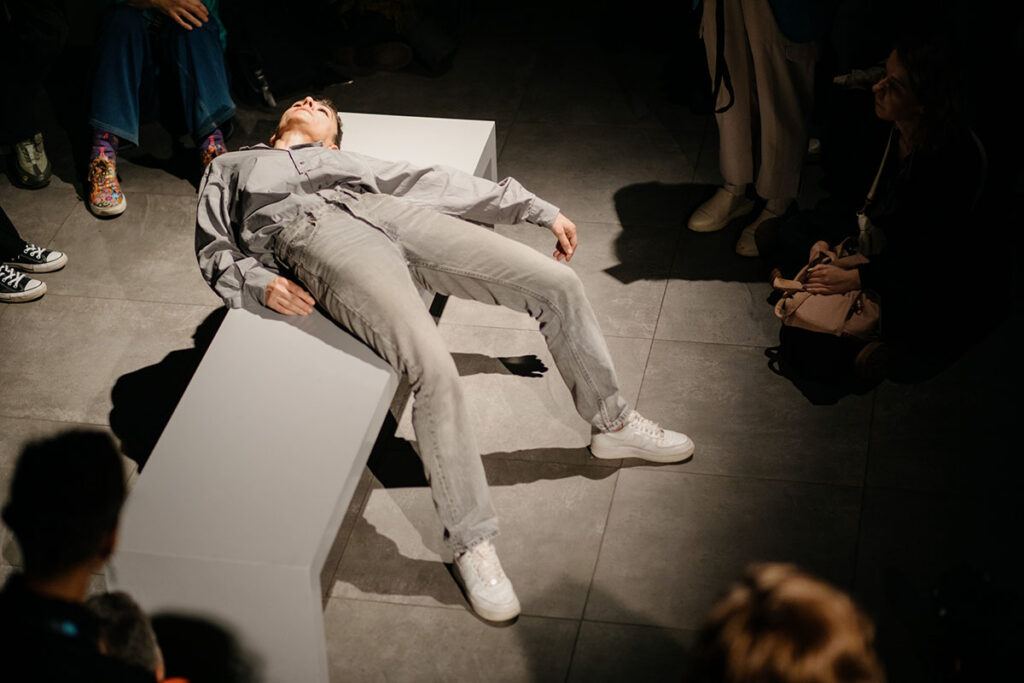
The opening has spectators gathered around a white bench, close enough for the usual distance between watching and inspecting to become slightly uncomfortable. Goro sits, then gradually seems to lose the privilege of sitting, her body slowly melting over and under the bench, seemingly liquefying. Every almost imperceptible gesture – a hand sliding across the rim of the bench, a leg twisting, a head bending – is slowed down and taken apart. After this carefully constructed dripping away, the audience is moved into a more conventional stage arrangement. Microphones and stands wait across the space, an ASMR demonstration follows. Then comes the bath-to-window passage, where a short distance across the stage is stretched beyond reason, Goro’s naked body choosing the long way between two objects that should be easy to connect. She contorts through the route, ending half outside the window, in an image that makes real escape look almost impossible. The final sequence is more recognisably theatrical – an actress past her golden years speaks about the ageing body that no longer obeys. It would be tempting to call this the human ending, but that would be unfair to the earlier sections. The body was human all along, but here it is simply given language, vanity and a dress. Through all these metamorphoses, Goro does not disappear, but neither is she allowed the comfort of one coherent self. What TELOS thusseems to be saying is that the end can paradoxically be relieving and agonising at the same time.
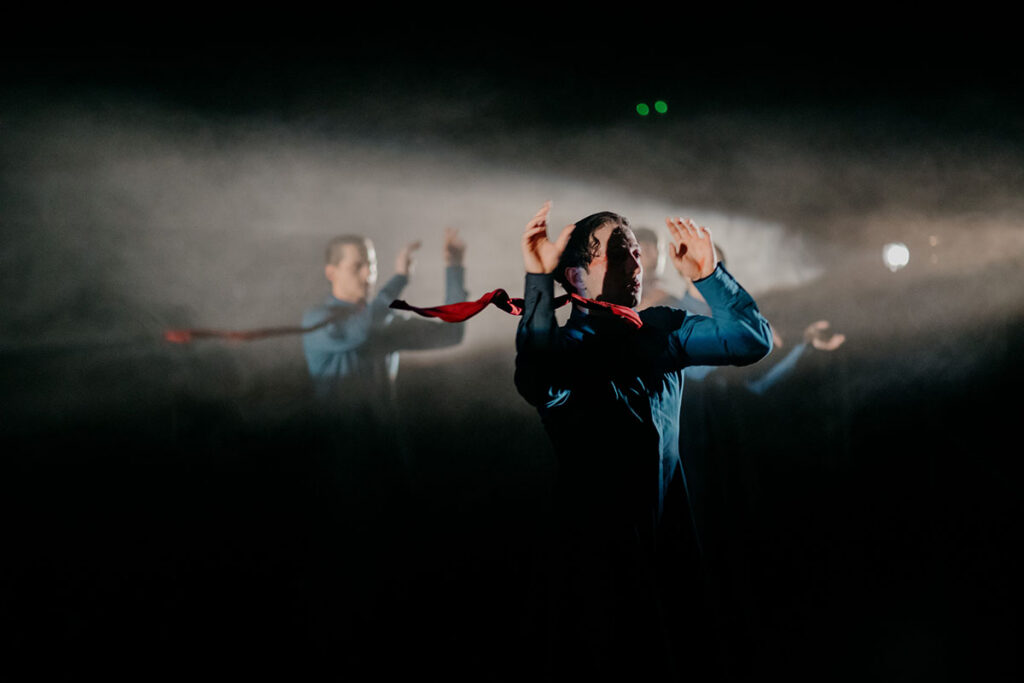
Deyan Georgiev’s Last Orbit rehearses the end at a very different speed, and this is both its provocation and its charm. Georgiev, whose solo Wired was selected to be part of Spring Forward 2023, seems less interested in what comes before collapse than in the strange suspension that follows it. The four performers, Bianca Braunesberger, Marina Haralambova, Alexander Gochev and Georgiev, begin in blue coats and red scarves that float behind them with a storybook stubbornness, inevitably hinting at Antoine de Saint-Exupéry’s Little Prince imagery. Their floating is, of course, engineered. Each performer wears a platform on one leg, hidden well enough by Viktor Georgiev’s lighting design that one notices it only by looking closely, and from this small asymmetry comes the work’s slow, astronaut-like bounce. The movement rises and falls from one leg to the other as if gravity were, for a moment, suspended. Repetition turns into a kind of orbital thinking, with bodies and objects circling again and again around invisible centres. At the end, when each performer holds soap bubbles on the palm like tiny planets that can vanish if handled wrongly, the imagery of the piece becomes beautifully delicate. Last Orbit imagines the end as an escape from reality into faraway universes where time is more fluid. For some spectators, the work’s intended slowness will probably sit very close to impatience. Yet, I strongly believe there is boldness in allowing crisis to lose its urgency. Collapse, in Georgiev’s universe, is less of an explosion and more of a change in the properties of time.
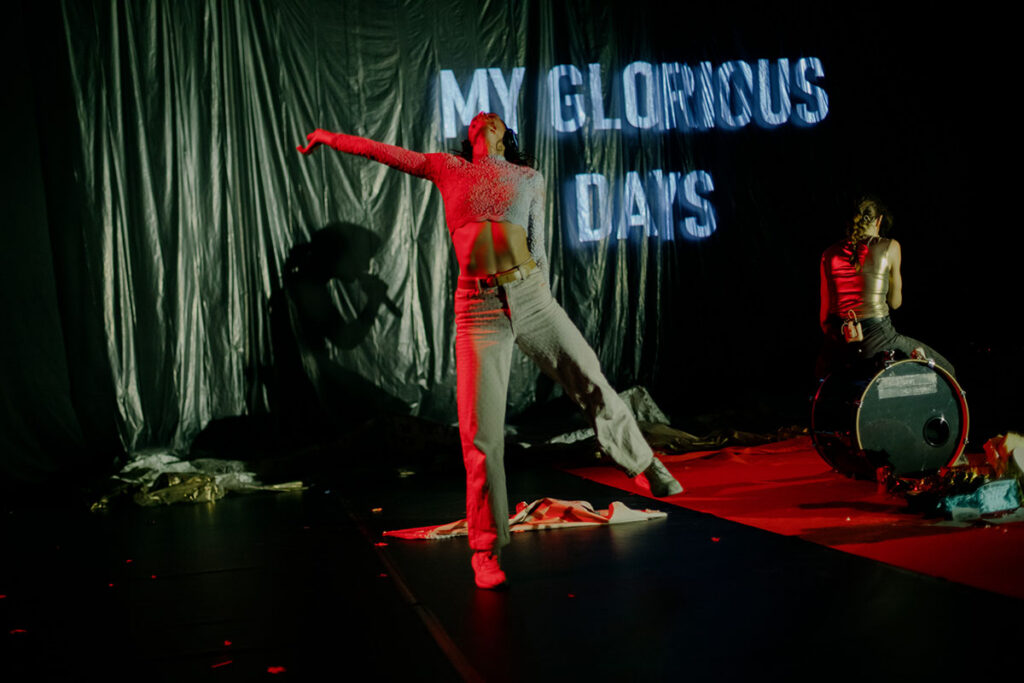
Chara Kotsali’s IT’S THE END OF THE AMUSEMENT PHASE, brings the end back from outer space into recent history, which is less clean and much louder. Kotsali, whose to be possessed was part of Spring Forward 2024, works here with Sofia Pouchtou and Christina Skoutela as performers and material co-creators, building a dance marathon that speed-runs through personal and collective history. The title sounds like a warning, but Kotsali is not staging the end as apocalypse so much as the exhaustion of progress as a narrative one is expected to keep believing.
On stage, the end of amusement is also the end of being able to pretend that amusement was ever innocent. The three performers dance, sing, play and run (both physically and metaphorically) through an overload of cultural memory, where fun and propaganda begin to overlap. The work is strongest when it refuses nostalgia its usual privileges, being “not nostalgic for the days that are gone / but rather afraid for those that won’t come”. It does not look back at youth as a lost paradise, nor does it treat the present as a uniquely fallen state. Instead, it stages the personal ending of youth beside the collective suspicion that the world has been rehearsing its own ending for quite some time, culturally, socially, and technologically. The performers do not stand outside that process and comment on it from a safe critical distance, they dance their way inside of it: “Does the future make you horny? Is it killing your sleep? So go on, fuck it hard and let’s move to the beat.”
TELOS, Last Orbit and IT’S THE END OF THE AMUSEMENT PHASE do not make the end clearer. If anything, they make it less available as a clean dramatic event. Goro’s endings accumulate through roles and textures of performance, Georgiev’s ending drifts into a vacuum where time has lost its usual usefulness, and Kotsali’s ending runs straight through the entertainment machinery of recent history. None of the three is interested in closure as comfort. Each keeps the body active inside conditions that should, by all logic, have already stopped.