

First read Part 1 of this text
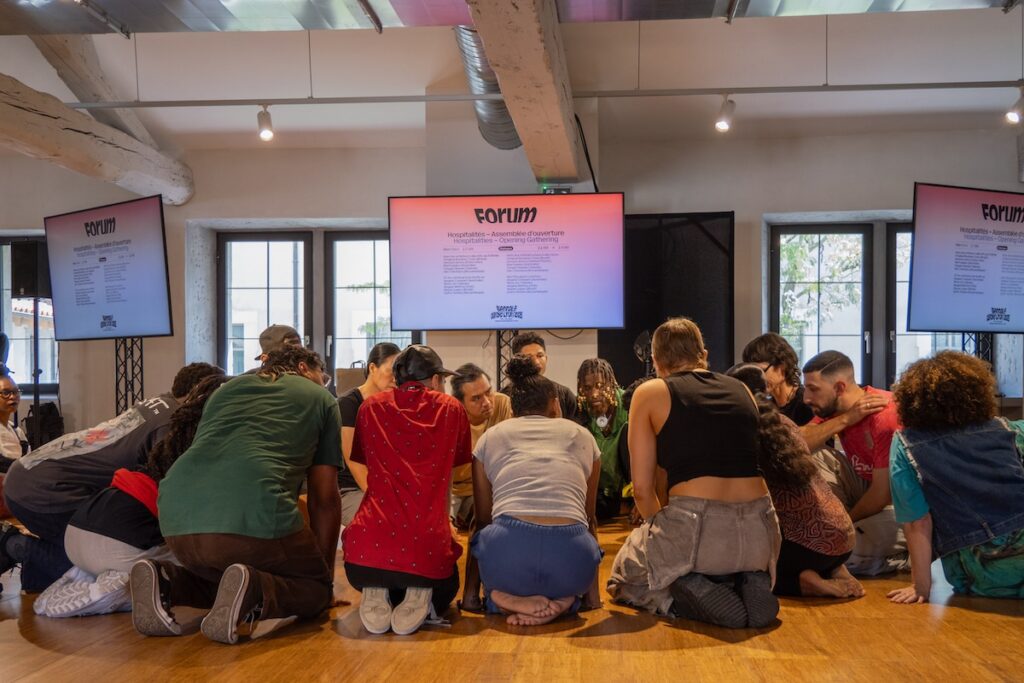
In the Forum, giving the floor to artists from Indigenous communities and colonial-impacted backgrounds is part of an attempt towards forms of reparation. The sentence keeps crossing my mind during those conversation days: we are alive in a time demanding reparation, from people, lands and memories wrecked by past colonial actions. And dance, working with the body, has much to do with this.
Māori dancer and choreographer Victoria Hunt speaks in dialogue with Rachael Swain from Australian company Marrugeku in a session called ‘Dance as New Ceremony, Truth-Telling and Re-Matriation’. Hunt works at the intersection of colonial heritage, ancestral traditions and reclamation. In her most recent piece, her dance partner is Hinemihi, a sacred ceremonial meeting house that once stood in her native land Aotearoa/New Zealand. The structure was dismantled and shipped to England, Clandon Park, in Surrey during the 19th century. The emotional weight of her presentation fills the room. Sitting in front of me, Marrugeku co-director Dalisa Pigram and adviser June Oscar both nod in recognition. It feels as if an ancient deep sorrow is collectively shared at this moment, regardless of our places of origins. The sacred house, wrenched from its country and displayed as an exotic curiosity in a British park, might finally return to its rightful place soon.
As she does consistently throughout the Forum conversations, Rachael Swain, artistic co-director of Marrugeku, situates herself in the world and on the land she comes from, presenting herself as a Pākehā of Scottish, Irish and English descent. The term Pākehā can be used for a person from British or European ancestry in New Zealand. And it raises another complex and stimulating question: how to be a good guest on borrowed land? For being a guest is also a practice, so how does one inhabit someone else’s land respectfully, while remaining present to the traces of history, oppression that saturate it? How do we nurture dialogue without claiming to fully understand or represent? These are ongoing exercises in listening, observing, and inhabiting the unease.
Witnessing Victoria Hunt and Rachael Swain in dialogue makes me think about one sensitive stake irrigating our present, finding ways to be fully alive while being attentive to the ancestors, but not to walk around being burdened by the violences from the past. Asking ourselves again, collectively but also individually, about the possible rightful ways of reparation, remembrance and thus taking actions. For centuries, “safeguarding” cultural artefacts, removing Aboriginal and Indigenous objects to exhibit them in western museums was considered as an act of care, protection. Today, multiple movements of return challenge the paradigm, and sacred objects pillaged by colonial empires are being handed back to their lands and communities. This process is giving way to experimental dialogues with ancient beings, as in Victoria Hunt’s work, or also French-Senegalese filmmaker Mati Diop, who in her 2021 feature film Dahomey imagined giving voices to the haunted statues of Paris’s Quai Branly Museum, articulating their own stories and wishes to return to Benin.
The voices of the displaced are no longer whispers in the mist, they are clear, insistent and sometimes uncomfortable to listen to. It is no longer a brr brr sound, from which the Greeks formed the word barbaric to name those speaking foreign tongues, hard to comprehend, drawing the line between who is a stranger as opposed to a member of their own people. All the artists and curators speaking their native and often threatened tongues, presenting themselves by describing their families, lineage, land and waters, fuel this turning-point of history we are in, growing counter-narratives. There is a lot to unpack in just one body, one vessel as June Oscar said. Each body carries stories, genealogies, and cultural legacies. To host in this way is to allow these layers to coexist, to ripple out into the room and to be received by others, to see what happens then. Demands are articulated, power position holders are put in more and more uncomfortable seats. This friction creates, as Brazilian Forum curator Nayse Lopez phrases it, “interesting spaces of awkwardness”. This juxtaposition of historical weight, ethical responsibility and creative acts is precisely what the Forum hosts, whether by design, circumstance or happenstance.
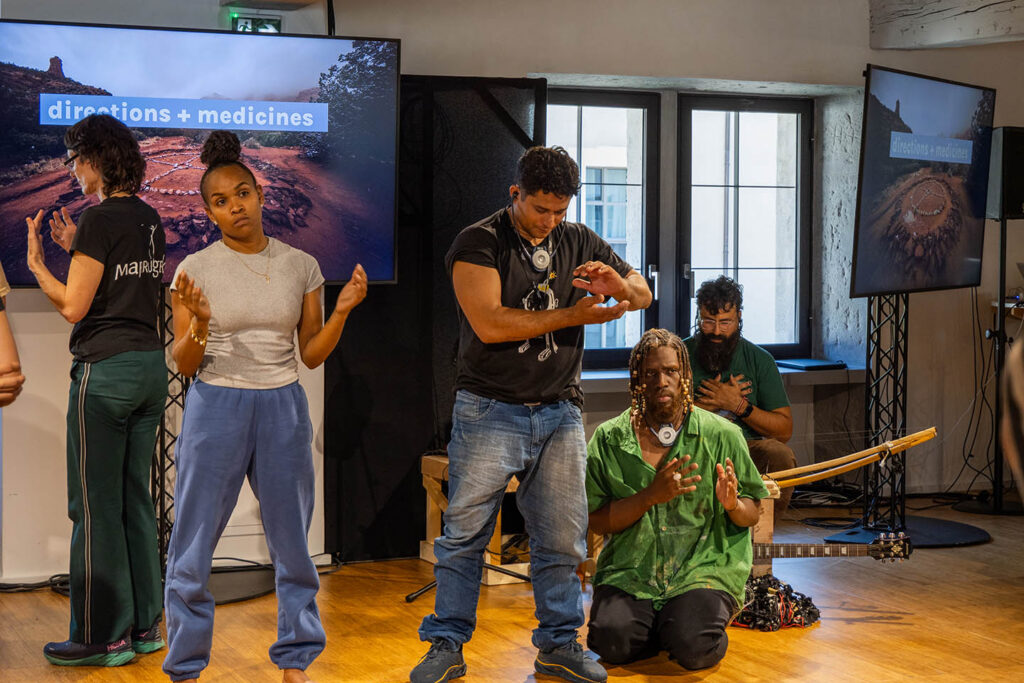
Being hosted in a plurality of practices also means experiencing discomfort in multiple forms as an audience. devynn emory, nurse and independent dance artist, presenting themselves as “an hospice worker in the collapsing US empire”, guides us through a shared ritual called he hollered like an animal: (Chipalamu alàshi aèsës). Based on the medicine wheel, guided by emory’s voice, the somatic practice walks us through the exploration of seven points or layers in our body. Moving through the process we are invited to “breathe into the home of you”, to notice our sides and peripheries, to inhabit our space fully. Eyes closed, each of us chooses to be sitting or standing for the duration of the practice. Holding the space with gravitas, emory appears to me in this moment at a crossroads of care practice, attempts at reparation, dialoguing with their own multicultural and perhaps conflicting communities, and initiator of a pure performative gesture. The ritual is at once intimate, collective and again awkward, as part of the process. How do we maintain attentiveness without collapsing into performative gestures of solidarity?
In such moments, hosting is a captivating notion when not focused on control or comfort, but rather on offering a layered, complex space that provokes thoughts, dialogue and reflections. Taking a seat at this kind of table, one must be prepared to confront assumptions, unlearn habits, and challenge gazing patterns. Through these practices, the Forum models an approach to hospitality that is not about passive reception but uncomfortable co-existence, noticing and responding to the multiplicity of lives, stories and bodies gathered in the room.
The Forum invites us to maintain critical awareness and question the terms. But this attentiveness must extend beyond its rooms and walls to inform our actions on the outside. Recent events, such as the racist aggression against the choreographer Dorothée Munyaneza, musician Ben LaMar Gay and the poet Julianknxx – insulted and beaten up in front of a bar in Lyon, after performing at the Biennale – underline the urgency of all of the above being not purely theoretical. Ethical hosting demands actions outside safe spaces, to bring the Forum’s principles into a world that does not currently welcome such desired plurality, dialogue and coexistence.
The work of hospitality whether in dance, cultural practices or everyday life is ongoing. May the Forum’s broth keep us warm and alert for all that is to come.