

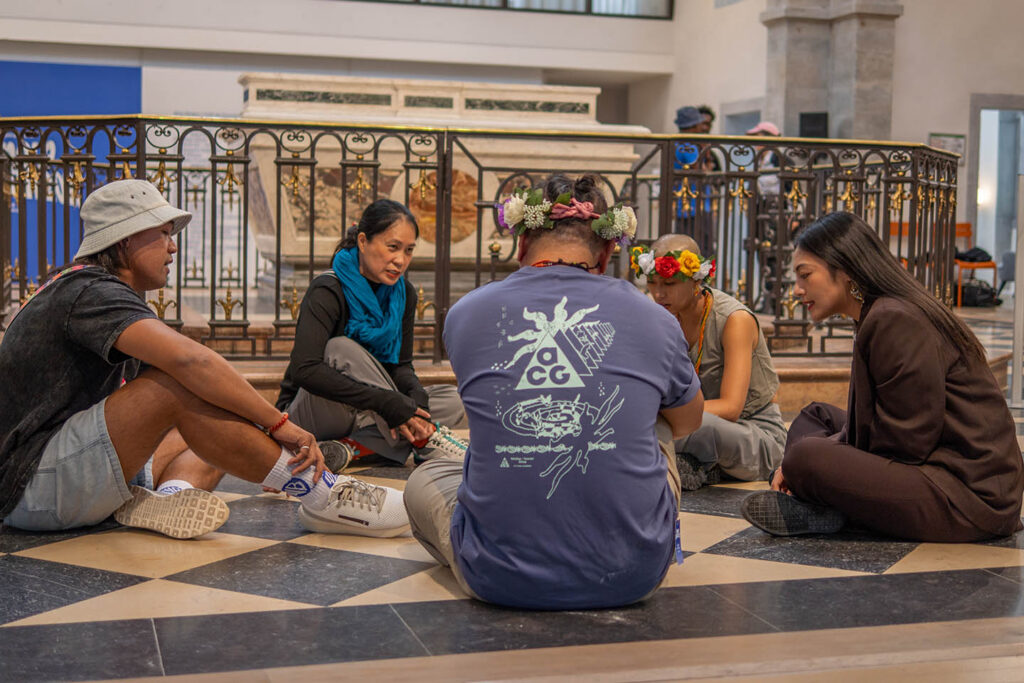
Like any rich broth, the Forum simmered on low heat for a long time. Over the course of three years, Angela Conquet, Australian curator and coordinator of the rendezvous and Tiago Guedes, Portuguese director of the Biennale and of the Maison de la Danse de Lyon, put together an artistic team, working with five curators from five continents. Each curator invited dance artists from their local contexts to be present in Lyon. Hospitality became the sheltering word under which the gathering would take place. So, what to expect when finally taking a seat at the table of hospitality in September 2025? What are the hosts invited to taste and share? Who is hosting whom, and how?
The hosting place of the Forum, the Grand Hôtel-Dieu – a former nun-run hospice – appears as an open sesame to give food for thoughts. What does it mean to hold an hospitable space? To create room for provocations and disagreements while still offering fair ground on which differing views may meet? Looking at the etymology of host, the Latin hospes binds together both the one who welcomes and the one who is welcomed. Hospital, hospice, hostel all share the same root, being places of refuge, care and rest. The Hôtel-Dieu used to be a place to welcome those considered vulnerable or cast aside, too poor, ill or abandoned to be part of the productive body of society.
Yet, only a stone’s throw away from host lies hostility, growing from the same root. To host is to either welcome a guest or an enemy, suggesting a threshold moment on which one stands, unsure who one is dealing with. The point here is not the binary – enemy or friend, sick or healthy, able or disable – but the question of who draws these categories in the first place, who decides who enters or stays outside, and who is ultimately left at the margins. Welcoming and sidelining, opening up the space while relegating some to the side can be made via very subtle moves.
In his lecture-performance Sweet Discomfort, north American scholar and choreographer Thomas F. DeFrantz pushes such margins and overturns some stigmas. In ten points, he delivers a pedagogical lecture to a predominantly white audience about black culture. DeFrantz carefully, and humorously, dissects the biases and mechanisms that we keep producing and reproducing. “Stop using black references in your dances as empty symbols. Show respect when you work with black dance” or “Stop trying to understand my blackness”, “Dance is not representation; it is action”. If dance is action, then it is put into practice here and now. We in the audience are allowed and encouraged to ask questions, yet DeFrantz leaves them unanswered. We are put in the position of being ignored – a sweet discomfort? – and thus what is offered is to remain silent, to listen, take notes, attempt to understand better what is at stake. So that once we leave this conference room, maybe our conversations about the tokenisation of black artists or about matters of cultural appropriation in dance might shift, move, evolve. Learning to decentre oneself, to step out of the way, or simply not to do something can be a form of teaching.
Learning to inhabit discomfort and disagreement may be a way to grow, instead of functioning in a well-known closed circuit, as we are often wont to do in Eurocentric contemporary dance networks. There is value in co-existing within thought-provoking questions rather than nodding along to keywords we’ve all heard before, repeated across dance gatherings in recent years. Maybe hosting thinkers and movers from more distant networks, places, communities is precisely what it takes in order to shake things from within, to compel us to look at ourselves and our practices differently. When a foreign body enters an organism, it disturbs the host. Here, the Forum attempts multiple grafts within a particular milieu of contemporary dance, and some of these succeed in poking the “ecosystem” and some of its cultural habits. Going further, maybe this could be of help, as nurse and dance artist devynn emory puts it, to “reduce the inflammation of the western body”, to find cures and pathways out of a globally dysfunctional system.
Hosting others also means incorporating their words, their vocabularies, their ways of doing as they unfold, without attempting to dominate or simplify them. It means recognising that artists’ work is situated, emerging from specific histories, geographies, and material conditions. Nayse Lopez, artistic director of Panorama Festival in Rio de Janeiro, puts a kick in the discussion by declaring that the era of curators and programmers is over. During ‘Conversation on the beginning, middle and the beginning’, she raised that pressing question: who are artists actually making their work for? Is it still meaningful to travel halfway across the globe to present, teach, and learn? Would the urgency be to share the work with the multiple communities where companies actually live and create? But then with what funding and support? Her stance is sharp, softly teasing, suggesting that western Europe is behind, caught up in the logic of artists waiting to be chosen, dependent on programmers’ invitations.
By her side, members of Original Bomber Crew from the city of Teresina in the state of Piauí, Brazil, continue. “There are no dance degrees or equipped venues where we’re from” – so dancers occupy autonomous spaces to rehearse, teach, study, and create. Their use of available spaces echoes the existence of quilombos, communities formed by runaway slaves in Brazil. The quilombos are structured around “self-construction, self-organisation, mutual aid, and deep mistrust of state power”. Such spatial and social organisations give rise to creative forces. The work created in such contexts is not made with export in mind, at all costs. Instead, it is here discussed as a hint for our possible futures, coming from places where economic precarity and disappearance of public funding already redefined cultural wealth.
It echoes a point raised by Tiago Guedes while speaking about ‘Hospitalities as responsibilities’: the urgent need to abandon an “extractivist policy” of programming. It encapsulates the need to think about an ecology of touring and producing dance pieces as well as questioning the gaze power dynamics. Who is watching what, in what frame? – to circle back to DeFrantz.
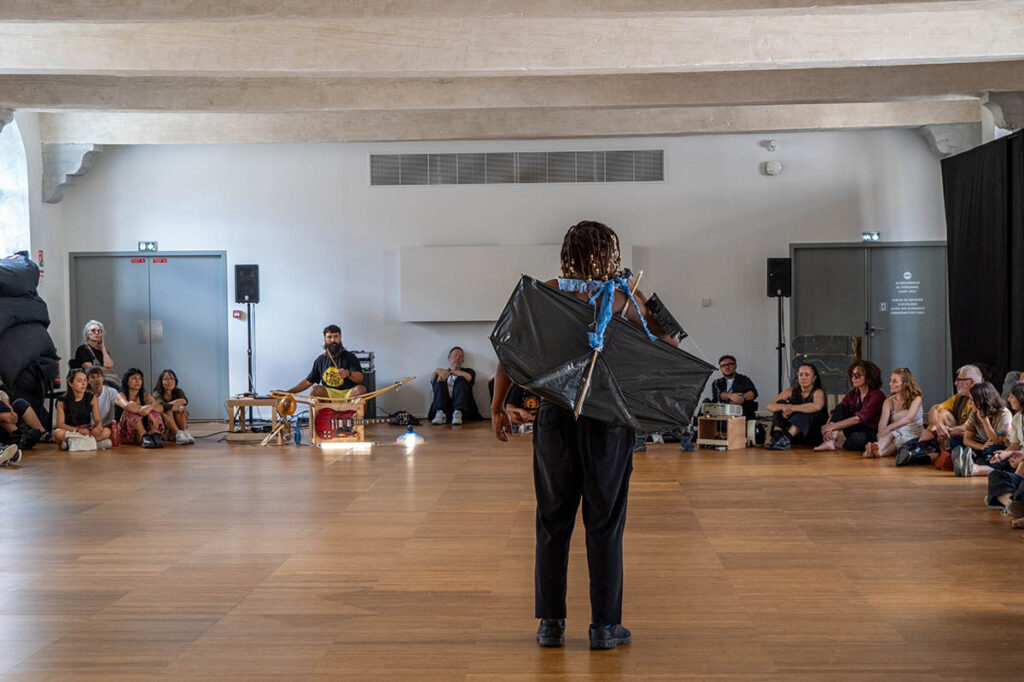
Thinking about that, I find myself in a state of discomfort at the end of MARGIN performance by Original Bomber Crew. In a pristine white cube, we are invited to sit around as the performance begins. The work is grounded, mirrors its socioeconomic context of creation: cardboard set, no lighting, traditional instruments played live and a choreography intertwining break and capoeira moves, representative of dança quebrada, signature of the crew, which can be defined as a mix of hip hop moves and movements from everyday life and traditional cultures. Being hosted into Bomber’s world is an invitation to inhabit their creative process. Towards the end, a hug shared in the centre by the dancers and musicians turns into a collective huddle, audience massively joining in. Some might find it a heartwarming conclusion to a performance; I feel a slight malaise. Why? Something is suddenly quickly resolved, with softness, whereas until that moment the frictions offered a way of thinking the distances between the worlds gathered in this white cube. As if a final point had been too abruptly given to a big conversation that needed much more time and space.
By digging deeper towards the roots of hospitality, Latin also tells us that the relationship between host and guest is one of compensation. Hostire means to pay back, to treat as an equal, while hostia designates a sacrificial victim, offered to balance out gods’ anger. Cohabitation always implies a need to even out. That’s for the teaching from Ancient Rome, but how does it translate within the context of necrocapitalism? How do we begin to compensate for hundreds of years of colonial oppression, extractivism, dispossession, systemic racism, and profound inequalities?
Now read Part 2 of this text