

“Art is like having a dog.”
An acquaintance of mine said that one evening after leaving a gallery opening, where he had struck up some interesting conversations with some interesting strangers – and that in turn had reminded him of how, earlier in the day, he had done the same with some people who were out walking their dogs. The dogs, like the art, had acted as catalysts and conduits by which different and sometimes disparate people could connect to each other, in ways that they would not otherwise have managed.
“I’m not being derogatory about the art,” he continued, “I’m being being serious about the dogs.” (He is, by the way, an artist himself.) He had been reading a book called How Animals Heal Us, by Jay Griffiths, which explores the manifold ways that animals not only do us good – in body, mind and soul – but can restore us to goodness; that is, heal damage that we may have done to ourselves, and to others. Indeed, the book goes further: without animals, we would be less than human, and lesser humans. This is in accord with ecologist Paul Shepard, who wrote: “The human species emerged enacting, dreaming and thinking animals, and cannot be fully itself without them.”
Seen in that light, “art is like having a dog” starts sounding not like a casual dismissal, and more like high praise indeed.
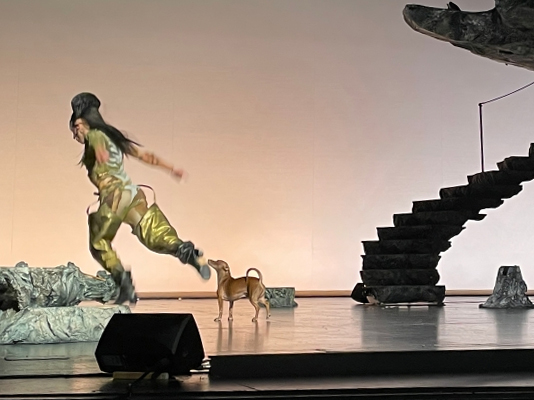
Such thoughts came to me at a performance of Último Helecho by Nina Laisné, François Chaignaud and Nadia Larcher, at the Lyon Dance Biennale. At the curtain call, Chaignaud and Laisné’s two little dogs Mirum and Zorongo bounded onto the stage, brimming with frolics and friendliness. We loved this almost as much as they seemed to: it warmed our hearts, softened our critical and performative armouries, and made everyone seem more human, including the dogs. Somehow, the dogs had bridged the gaps between performance and audience, indeed between one person and the next, and enabled us to become an “us” – different, yes, but together at this moment, in this place.
This sense of being different but together within a shared world is the basis of ecological consciousness – a topic that wove through the Forum of the Biennale, mainly in the context of Indigenous knowledges and practices. But there was something else that struck me about dogs and us, here at the Biennale: that dance, being founded on our nature as animate beings, is the most animal of our arts. Perhaps that’s why it is so often considered as lower than other forms – an underdog art, if you will – and why those who defend dance too often reach for highfalutin concepts and cerebral arguments to do so. But surely we can flip this perspective, and treat it instead as high praise indeed.
Where are the other On Record Epidogues? Here they are!
PT.23: RIP Rupee
Baltic Dance Platform 2024: Morocco
Moving Balkans 2025: Watchdogs