
“I come from the future.” The pronouncement was made by two people on separate occasions during the Forum of the Lyon Dance Biennale. The first was Argentinian musician Vanesa García, on the stage of the Opera de Lyon, just before the curtain rose for Último Helecho, the latest staging by Nadia Larcher, Nina Laisné and François Chaignaud. The entire production team appeared – dancers, singers, musicians, light and sound designers, company producers – led by García, to open an evening that followed a day of strikes in France. A call to “block the country” had been circulating throughout the month of September, to protest against the liberalisation of healthcare, of working conditions and globally harsh austerity measures. Also, to demand consistency in arts and culture funding. In the afternoon, Chaignaud’s team marched in solidarity with the strike in the streets of Lyon, and decided to perform that evening, starting by speaking out first. And so, after entering through the grand classical façade of the Opera, adorned with a banner reading Culture en danger, the whole audience is listening to the voice of a musician who came all the way across the Atlantic Ocean.
“I come from the future,” García says calmly, referring to present-day Argentina, where Javier Milei, president since 2023, has been slashing funds in the arts, with a literal chainsaw in hands, his signature move. She unveils a simple yet striking fact: the piece we are about to share is an endangered species as we speak. With its multicultural teams from Argentina, Peru and France, its operatic staging with an imposing set, magnificent costume work, several live musicians and – one imagines – extensive research work beforehand to dive through traditional folk songs, music and dances from Argentina and Peru. Her words underline that ambitious and costly work is threatened by the increasing lack of money injected in the arts, both there where she comes from, and also here and now. It resonates with the state decisions, coming one bill after the other, slashing the supposed grandeur of the exception culturelle française, its gilding tarnished. García’s warning is coming from just one step ahead, the immediate future, as in a dystopia.
The second instance of coming from the future is from Nayse Lopez, Brazilian curator of the Forum and director of Panorama Festival in Rio de Janeiro. Coming from the future in this context means living in a country battered by the fascist previous government of Jair Bolsonaro, also resulting in the instant dismantlement and closing down of cultural institutions. Lopez, a skilled orator, adds: “I came to visit you on the sinking Titanic here in Europe.” If a possible future without any state support is no news to anyone working in the arts right now, her words carry weight nonetheless. One sentence, heard twice, creates a ripple effect, sparks conversations among us, about our (un)preparedness for what is described as our future.
From these discussions, my Springback colleagues begin to imagine an alternative Forum. Full of practical workshops led by those coming from the future, who would share strategies, inputs and survival tools to keep showing and sharing works in countries overtaken by fascist regimes. A handful of us imagine this Forum focused on practical questions, how to move forward, share knowledge in times of crisis. That would be another way of putting care into practice.
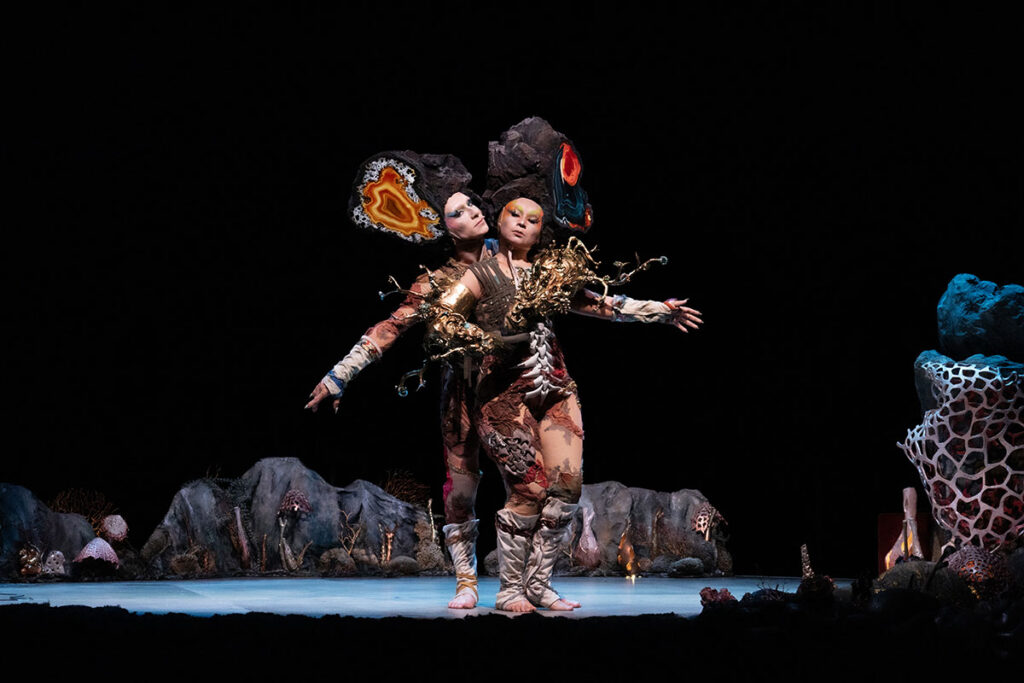
When the curtain finally rose on that night at the Opera, Último Helecho unfurled as a fine exploration, a weaving of voices, ancient instruments, melodies and transformations. The title means the last fern, sounding like a precious resource, evoking the origins of the music and dances intertwined with the cultures of Indigenous communities oppressed by colonialism. The set resembles a vast rock, or a cave, suggesting earth’s entrails, while the costumes evoke a symbiosis between nature and human beings. François Chaignaud and Nadia Larcher appear as polymorphous creatures, fused with vegetal and mineral forms, covered in materials like felt and red-blood pearls, turning their bodies inside out as if the viscera and skeletons were exposed. Their headdresses hold sacred stones, their breaths and songs visit the underground of their diaphragms, their feet stomping on the floor seem to be able to awaken the company of ghosts, performing ancient dances alongside them both.
As we were just invited to look towards the future, in an attempt to empower us to act, ward off a spell against darkness and invent counter-gestures, antidotes, Último Helecho seems to initiate a circular movement, discussing with the past, echoing some discussions in the Forum about the circularity of time. Non-linear conceptions of time emerged frequently in the talks, with the idea that life does not follow a straight arrow but moves in cycles. At one point, Sanjoy Roy, my editor and Forum companion, brings this quote by Kierkegaard into one of the many in-between conversations we have: “Life can only be understood backwards, but it must be lived forwards.”
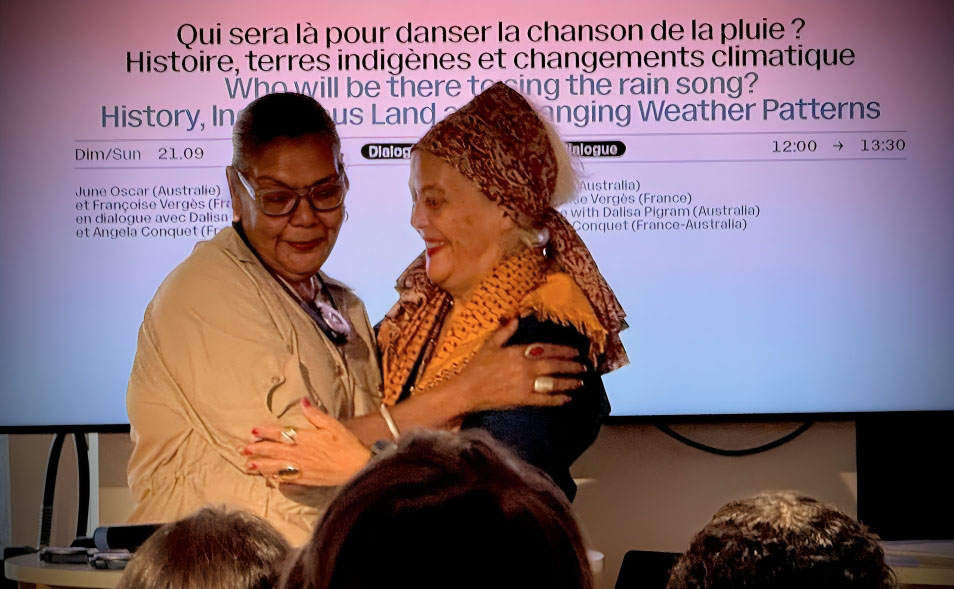
Looking back to move forward: this is collectively a process we find ourselves in. Reflecting on the past to inform the present and future. But this act of looking back can be undertaken with radically different intentions. Françoise Vergès, political scientist and historian focused on postcolonial studies and decolonial feminism, speaks with absolute clarity for a short time during the closing dialogue ‘Who will be here to sing the rain song? History, Indigenous Land and Changing Weather Patterns’. She brings into the conversation a much-needed attention to the French overseas departments, former French colonies, stating, “The colonial conversation in France today is relegated to the past, but we are not asking for apologies, we are asking to bring extractivism to an end now, in the present.” Not looking back in longing for an old world, feeding some dangerous fantasies about an idealised past, nor considering violence and suffering solely as part of the past. Maybe looking back, then, to keep alive the teachings and ways that are older than any of us.
At this point, the book Ancestral Future by Ailton Krenak, activist, writer and philosopher from the Krenak people in Brazil, provides insight. Krenak argues that the future is already present, held in the actions and wisdom of the ancestors. Surprisingly circling back to water – the element with which I began thinking of this Forum – the book opens thus: “The rivers, those beings that have always inhabited different worlds, suggest to me that if there is a future to imagine, it is ancestral, because it is already present.”
Here is an idea to cherish, if – as I consider in my third text from the Forum – we are generations of healers, menders, trying to piece together some broken remnants left to us, then looking back does not necessarily mean clinging to roots but engaging with practices that are grounded, in the living earth, in communal know-how. It is a plunge to attempt to open passages within the living world, to invent gestures towards more connections. If the future is ancestral, it’s like compost, as dancer and philosopher Emma Bigé might say. It holds the necessary resources for life to persist, deeply embedded in its dark soil. “We are living in a world in which we are forced to delve deep into the Earth to recreate possible worlds,” Krenak adds, inviting us to think about the porousness between species and our relationships with other beings, being able to be transformed by affective contaminations. In the darkest dark, deep into the ground, everything is possible. The future is there and yet it does not yet exist, so it can still take any shape or form. Darkness is full of possibilities. And we, being human – coming from humus as Bigé, seated on the floor, reminds us – should know about this, and she invites us to remember to give in to gravity to find some common ground, the one parameter we are all subject to.
As we are alive in this tension, between looking back and moving forward, we coexist in a world where historically oppressed communities fight to hold ground in a rapidly dying world, while fascists fantasise and are at work to feed their conceptions of idealised and falsified traditions, folklore. There is great attention to pay to ensure that folklore and traditions do not fall into the hands of retrograde forces. If we are in search of dances, songs, and rituals for the times we live in, it might be in the frictions between ancient rituals and contemporary responses that the dialogues become most interesting. Marrugeku company quotes the ‘Listening to Country’ research lab they conducted in northern Australia, which states: “We now find ourselves in this complexity without the necessary song, ceremony, or dance to interpret the interface of the old and new competing realities. We need to find new narratives, songs, and dances to respect the land.” Yet within the Forum it feels as if these necessary songs and dances are already here, all around, created by the companies in the present, drawing on the past to help guide us towards the future. It is both a movement of reconnection and projection, it is doing two movements at once, and this dynamic is keeping us afloat.
In the same way that, as Krenak writes, polluted rivers find new paths to flow underground, beneath the rocks, hidden from further human disastrous actions, we are in an urge to keep the plurality of species, languages, songs, dances, cultures alive. We are the custodians of this moribund diversity, while multiple layers and tensions coexist in the web of our present. This means witnessing ambitious dance pieces in a context that is unravelling, it means being in action and rest at the same time. It can mean listening a lot more and being quiet – those are actions too – in order to know where the next step is. The Forum can be taken as an invitation to layer up, bringing ultra-local customs into contact with international networking, and weaving a web made of different kinds of resources. In order to help decide where to set foot next, and on which future shared, sacred, secret grounds we will dance.
As the Forum comes to an end, the month of October begins, and Jane Goodall passes away. The primatologist left with a final warning, that stayed with me: “The greater danger to our future is apathy.” And I thought: well, one thing dance knows how to do, for sure, is to keep all senses and connections out and alert. Before leaving Lyon, I also keep the words written on cardboard at the end of Original Bomber Crew’s performance MARGIN. I leave them here below, as some final ingredients to fuel the transformations towards our futures.
Trust the community
Disappear when you have to
Listen to the circle
Leave some space
Breathe together