

Most of what happens in a dance performance, you could argue, is invisible. Everything that goes on inside the dancers’ bodies and minds is invisible: intentions, motivations, internal co-ordinations. Likewise, what we read into dance, our feelings, formulations, references and responses, are invisible. Yes, a performance is made of actions, materials and our sensory perceptions of them – but that is just a part, perhaps even a small part, of what “happens” in a performance.
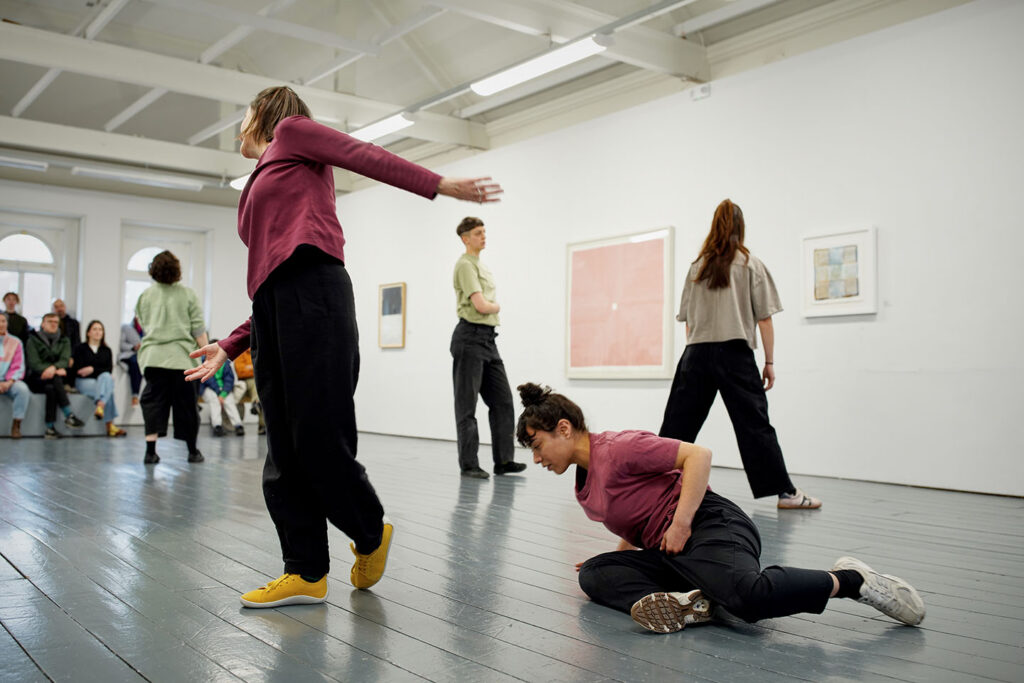
Some performances at What Next addressed the invisible directly. That is clearly signposted, of course, in the title of the work Specific Invisibilities: Dancing, a gallery-set improvisational study for five performers by the Parsley Collective, which aims to “draw attention to immaterial and invisible realms”. It’s interesting, to me at least, that they do this through very visible and material means: clear walks, runs, turns and drops, clear pathways of action, clear speeds and paces, clear time frames for each section. That much is perceptible, and there’s no attempt to hide this materiality behind stories and emotion and theatre: it is what it is.
So what is it not – or rather, not literally? I thought of it like an outline drawing in colouring book, where clear-inked lines give form to the “negative space” they contain, which we can then fill in with colour, as we wish. Something similar happens here: the material forms physical outlines that we – whether performers or audiences – colour with our imaginations. A quickening of steps feels like a hastening towards an unknown goal. Some chance encounters feel friendlier than others; some more random and others more deliberate. Each section holds hidden rules and regulations that the performers follow and that we cannot know, only imagine.
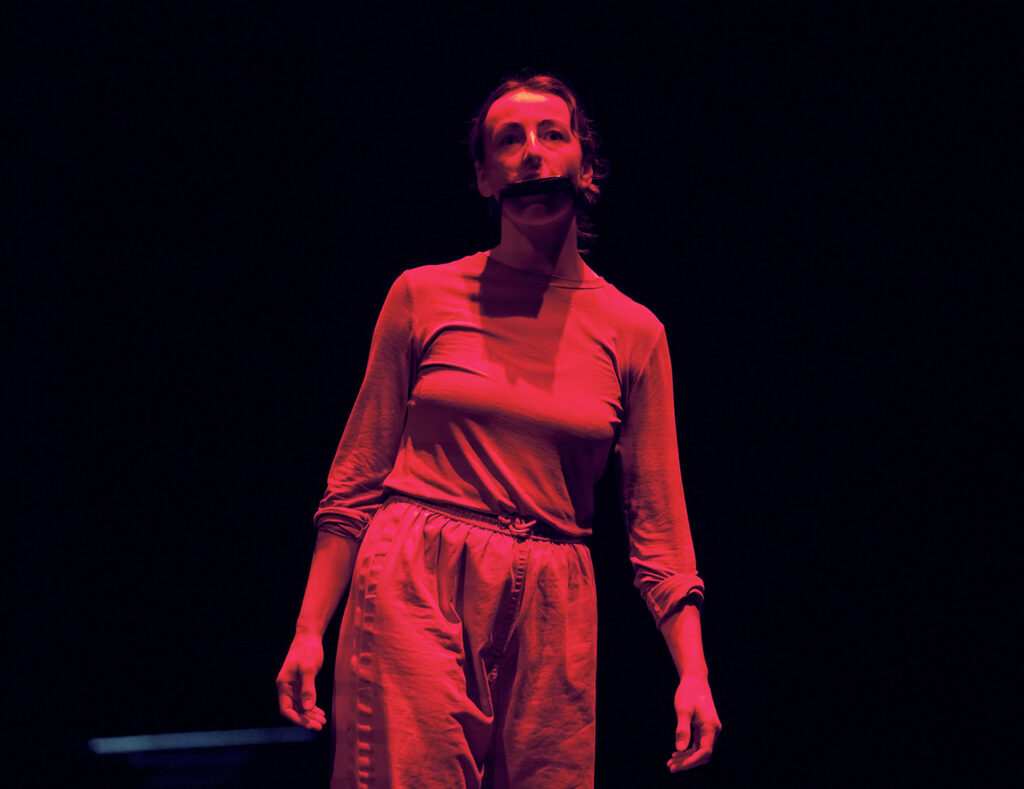
Elsewhere, works were interested more in making manifest the invisible insides of our bodies. Aoibhinn O’Dea’s Foot of the Lungs connects above all to breath, that air within us that keeps moving invisibly in and out, and sustains our very being. O’Dea does this with a very simple device: a mouth organ, strapped to her head, that passively registers the breathings that her movements – first sloth-like and animalesque, later more upright and humanoid – induce. Like a seismograph, it’s both a sensitive and a blunt instrument, highly responsive to the rhythm and amplitude of her breathing, yet producing a two-dimensional output from a multi-factorial source: basically two different wheezy chords, one for “in”, one for “out”.
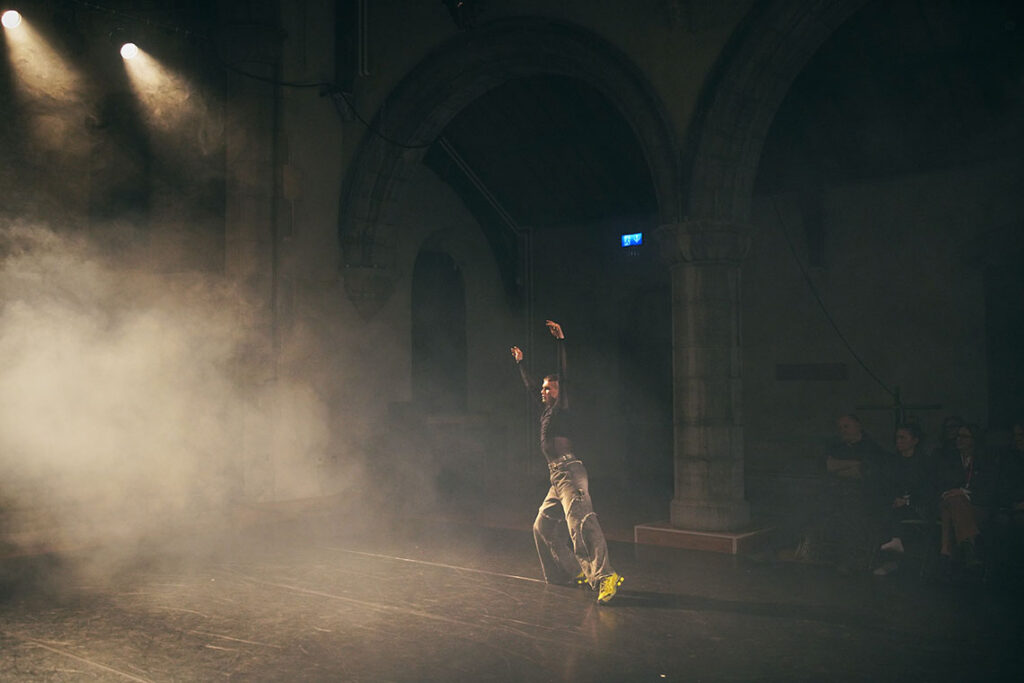
At one moment in babes, soloist gergő d. farkas unexpectedly oozes a dark viscous liquid from his mouth. Something that had been hidden inside the body becomes visible outside it. In fact, farkas tells me, the idea of “fantastic organs” – reimagined organs and systems (a digestive tract that ingests from below and excretes from above, for example) – underlay the research in this piece. How did I experience it in practice, though? For me, the performance seemed to be about something invisible – and also inaccessible. With Parsley Collective and Aoibhinn O’Dea, I felt I had apprehend something unseen; here, it seemed beyond reach. Farkas tells me that the piece grew from a university masters programme, and I thimk that shows. Or perhaps I am just fantasising the invisible hand of academia leaving its fingerprints all over the piece.
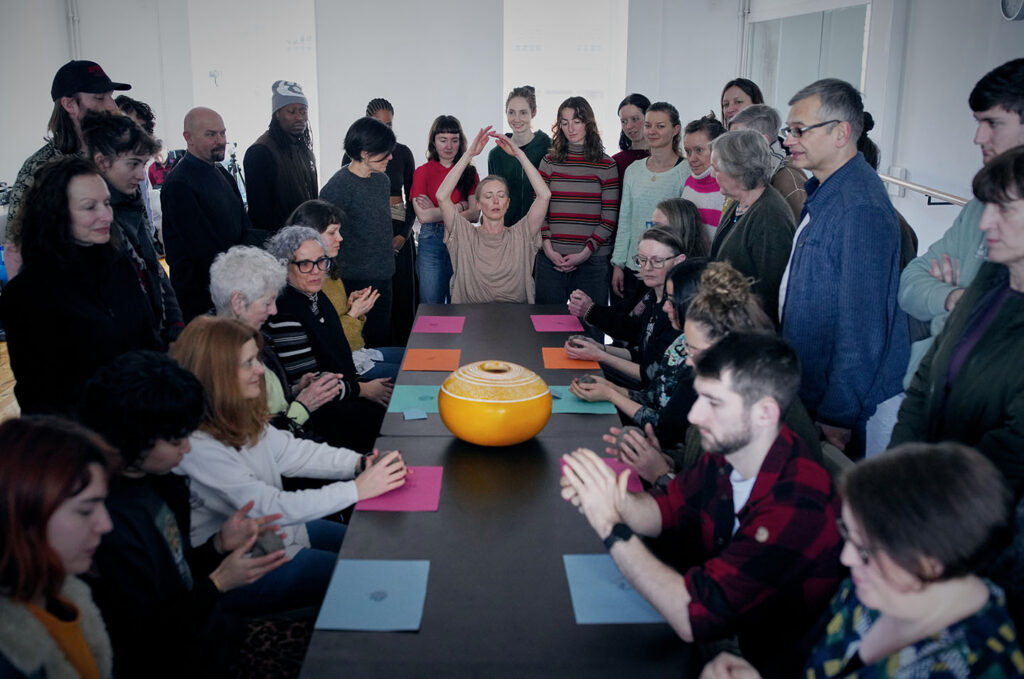
Organs are made not just accessible but palpable in Left-Handed Snake Drawing, a work-in-progress by Justine Cooper and Rebecca Reilly. Seated around a long table, participants were asked whether they had a body part that “needed some love” – and to manifest that organ by moulding a lump of clay in front of them. Thus there emerged a shoulder, a foot, a brain, and other bits and bobs that I couldn’t identify and, given their intimate nature, thought it best not to guess at. I’m not sure whether we loved them, or indeed whether the love made a difference, but I was sure of their manifestly material presence. They were literally there, on the table before us – totemic stand-ins for the hidden pains, aches and sorrows that we all feel within our bodies.
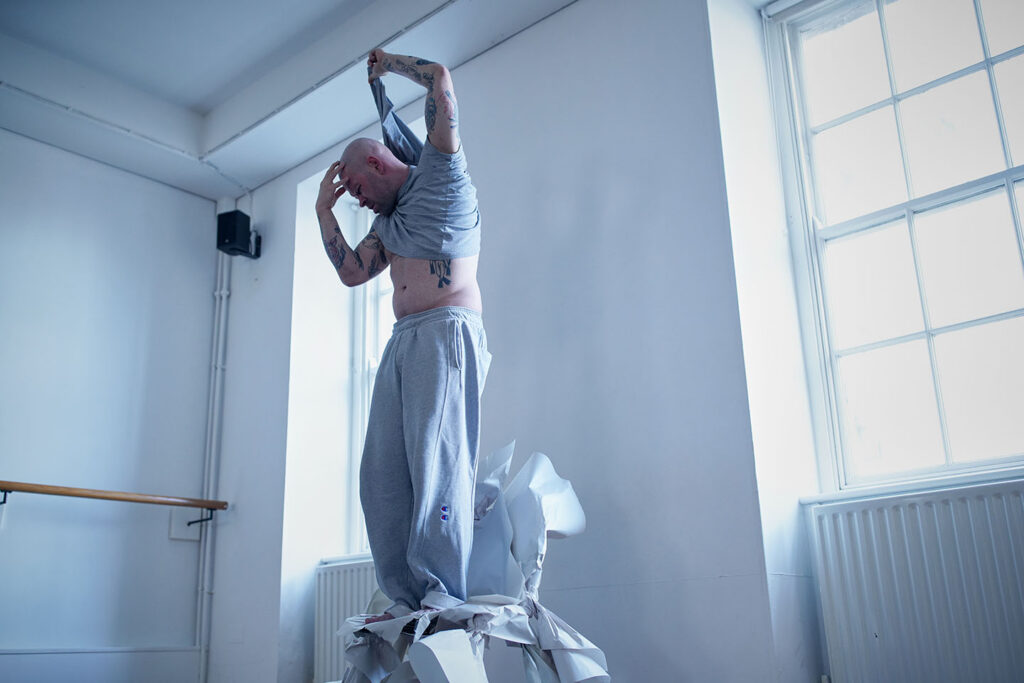
Another work-in-progress, Memory of the Skin by Matt Szczerek, refers to the body’s largest and also most visible organ: the skin. I include it here because its overriding impression is of some other, alien presence whether beneath the skin, scrabbling to get out, or scurrying across its surface. Szczerek’s fingers spider across his head, his fists bunch up and distend his t-shirt. What makes this invisible presence so palpably effective is not just the immediacy with which we can identify with the feelings of itching, tickling, chafing and pinching, but the evident rigour with which Szczerek orchestrates his own multilayered motions.
And that, I guess, returns me full circle. Kinaesthetic empathy, enabling us to identify with a performer’s physical or emotional interiority, is a powerful connector – but it’s not enough to build a piece on. The actions, materials and sensations of a performance may be only a part of what happens, and maybe a small part – but it needs to work on that level if the rest is to have a chance of working at all.