
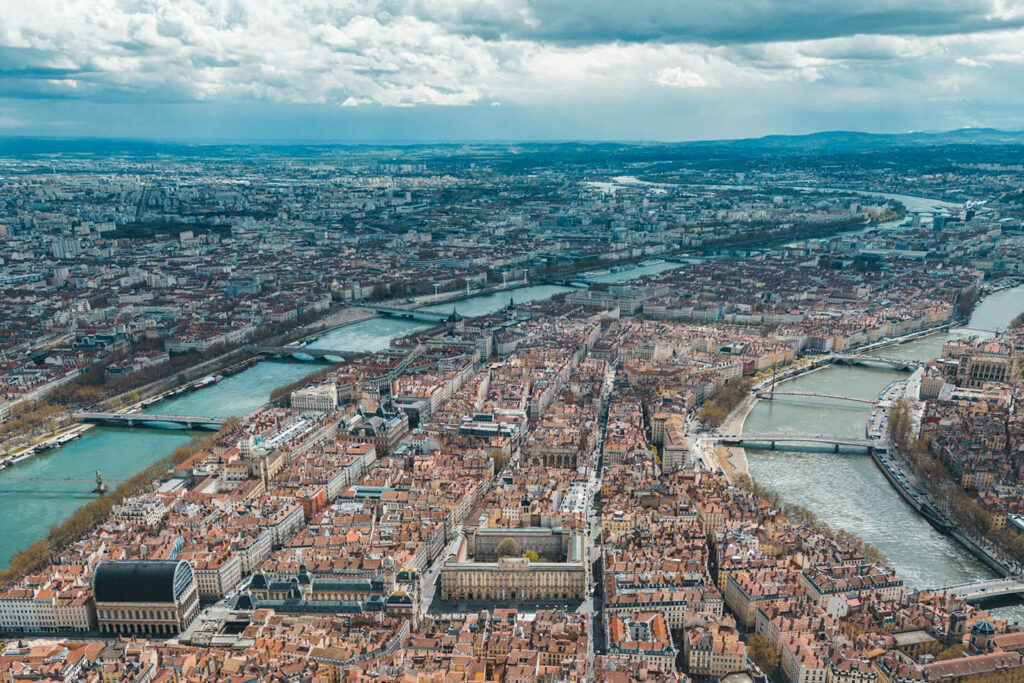
I arrive at the Forum of the Lyon Dance Biennale with water in mind. I had brought the recently published Le Parlement de l’eau by Lyon-based writer Wendy Delorme to accompany me, with the intuition that the book would somehow resonate with the conversations. Maybe the title of the final meeting – Who will be here to sing the rain song? –had something to do with it. Maybe it was the city of Lyon itself – built upon water, an archipelago before being redesigned by human hands and minds, its lands and waters tamed for development purposes – that suggested the company of this book.
On the first morning, walking along the banks of the Rhône and the Saône, the two imposing rivers weaving through the city, I notice the plaques indicating past flood levels and their deadly effects. In her book, Delorme investigates the former course of the Rize, a small river that once ran through Lyon until the 19th century, before being gradually diverted to the sewers, drained, put under in a context of intense urbanisation and industrialisation. The recurring floods are reminiscent of the presence of everlasting, not-so-tamed water after all. What could possibly go wrong here, in our coming present-future, in a world where the GIEC experts calculate a sea level rise of 1.10m by 2100?
Crossing waters, crossing lands. To reach the Grand Hôtel-Dieu – former hospice and hospital, current Cité de la gastronomie – artists, thinkers, movers and curators have crossed oceans, lands, continents from their own countries. Country, as the Marrugeku company shares with us while discussing ‘Dance, Climate and Contested Land’, is a word used by Indigenous peoples of Australia that encompasses more than lands and waters. Country includes all living beings, human and non-human, as well as knowledge, cultural practices, languages, spiritual and emotional relations in a dynamic of reciprocity. The word gives textures, layers, an intricate and sensitive complexity to the experience of being alive.
In this city situated at a confluence, country and water are very much the bedrock upon which questions of belonging, exploitation and colonial heritages are raised and discussed. A concrete ground on which we are invited, throughout the Forum, to try and shift perspectives, interrogate points of view and cohabit within a plurality of relationscapes, as philosopher Erin Manning puts it. A space where movements, affects, perceptions intertwine with relationships, all always in motion. That is to say that the places where people come from are not decors, and the invitation here is to try to unplug – or at least challenge – preconceived ideas, hierarchichal conceptions about origins.
The opening gathering sets such a tone. The artistic teams and curators – Original Bomber Crew and Nayse López (Brazil), devynn emory and Angela Mattox (USA), Marrugeku and Angela Conquet (Australia), Fangas Nayaw and River Lin (Taiwan), Idio Chichava and Quito Tembé (Mozambique) – take turns weaving a thread of songs, dances, words in the space. In the large conference room, a sea of chairs is parted in two, leaving a central open space. The air vibrates with excitement. A collective warm-up begins, a shared wave of energy, coming from the artists disposed in a central circle. Arms rest on each other’s shoulders, shoulders are massaged. A pink Free Palestine t-shirt pops out.
Original Bomber Crew shares a collective dance – arms hovering, dancer Allexandre Bomber wears a cape made of colourful recycled materials, a plaster crosses his face under his cap, like a mask. The floor is stomped, energies are stirred. O rio e o ceu – the river and the sky – sing the lyrics.
“We come all the way from the ocean,” continues Fangas Nayaw and his crew, sharing traditional songs from the Ami people from Taiwan, asking first the ancestors for permission to pass along the culture. The dancers sit in a circle, four nations looking outwards to four points in the space, addressing sacred songs to invisible beings as well as to us all around. The air thickens with textures; a great inner calm settles. The circle opens into a winding farandole, led by several guides. We are going to be the ancestors of the next generations, so what do we do? Who has the floor? How do we coexist? I cannot remember if I wrote that down from my inner voice, or because the questions were asked out loud during the ritual.
Idio Chichava, choreographer from Mozambique, takes over the energy with a song. How to be a collective, to question our co-presence as human beings? The practice starts with the image of a bottle of champagne, being solid and liquid at once, with energy under pressure bubbling in the centre. Marrugeku co-directors Dalisa Pigram and Rachael Swain remark that the space is now tuned up for deep listening, filled with knowledge-holders and keepers, opened to work from the gathering of our own stories, intersectionalities, histories. We learn in the process that the Free Palestine t-shirt is worn by a Palestinian artist based in Tasmania. Each practice is a proposal to dive into topics that will keep us busy for several days, Whose land is this? Who was here before? Which languages were spoken? Who are the knowledge-keepers now? And then? Who is in the room? Who is missing in this room?
As the room fills up with voices, ancient songs, it becomes more and more vibrant, with a whirlwind of energies stirred up. It is a beautiful choice not to begin with speeches or grand words, but with practices, with sounds that reverberate inside our skulls, rib cages, and all the way down our heels planted on the old hospital floor. As the sounds travel through bones and time, skeletons listen and ghosts gather, questioning the future by our sides.
I keep following the water thread. The next morning, crossing a passerelle on my way to the Forum, I see a man fishing on the river bank, pulling a fish out of the water. Upon arrival, devynn emory, choreographer/dance artist and nurse from Turtle Island/North America shares that they went with their kin “to the river, to connect and send whispers” as their own kind of welcoming ceremony. In There Are Rivers in the Sky by Turkish writer Elif Shafak, she makes such an invitation, as an echo: “If you have a hidden wish, something too intimate to share, you may just as well whisper it to a flowing stream, preferably on a Wednesday. The current will take care of it.” I ask the Forum’s Taiwan curator River Lin, a dance producer and artist working across performance, dance and queer culture, what is the story behind him being named River. He smiles and says that he chose it himself, as a fluid being deciding to appear as such in this world.
I like thinking about all these gestures, decisions and rituals, present or past, happening alongside the Forum, thus somehow being part of its choreography. Naming, choosing how to qualify, weighing words… this appears as a recurring gesture in the Forum.
In a near future, salty water may overflow while drinkable water grows scarce. In Le Parlement de l’eau, water entities – River, Delta, Ocean – speak for themselves in an assembly, held within the narrator’s head. Many of the Forum’s speakers, artists and curators seem to invite precisely this possibility, to speak and listen otherwise, to make room for the more-than-human, inviting the elements themselves to be part of the discussion as much as possible. From there, the point would be not merely to keep one’s head above the surface, but to learn how to swim side by side, to add different voices to the chorus of the rain song. Sensing the currents, the gestures and directions artists and collectives gathered here might point us towards. Treading water then becomes more than a gesture of endurance, but an active choreography of keeping balance, of trying to stay afloat together – not only for survival but as a wish to re-examine the quality and robustness of relationships, of relationscapes.