
“A work of art is never completed, only abandoned,” wrote French poet Paul Valéry. All artworks, then, are essentially works in progress.
An alternative approach: “I’m cookie dough, okay? I’m not done yet.” That’s Buffy Summers, from the cult TV series Buffy the Vampire Slayer, explaining her feelings about adolescence, being and becoming. “Maybe one day I turn around and realise I’m ready. I’m cookies.”
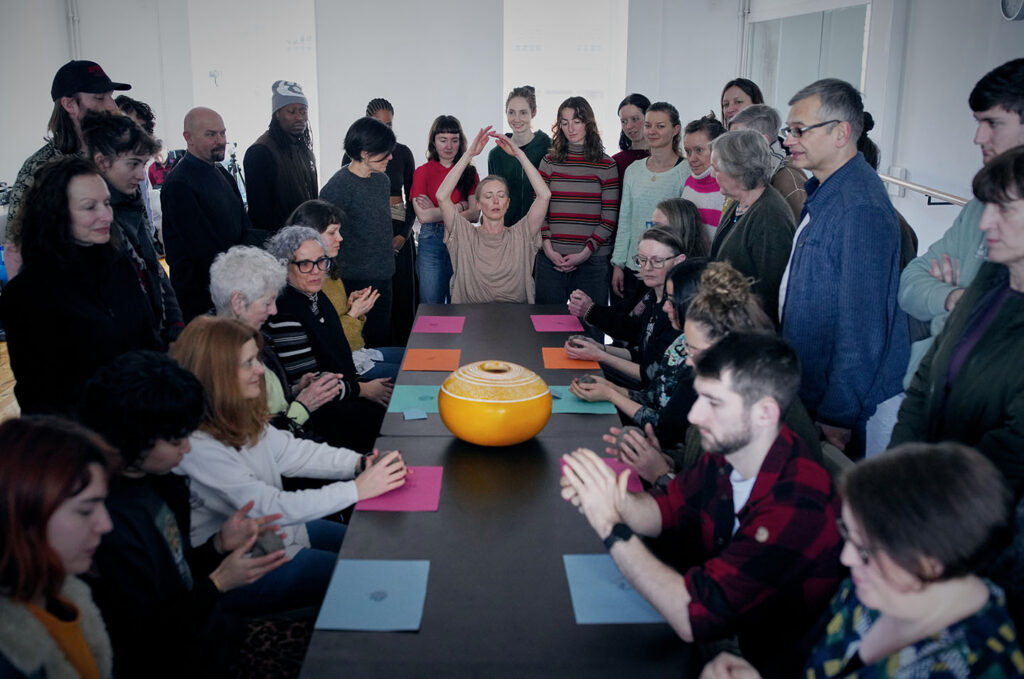
Whether you take the high road (Valéry) or – like me – the low road (Buffy), What Next provided an opportunity to reflect on what a work “in progress” actually is, by programming a slot specifically for them. The four works shown at What Next Studio – the first time the festival has tried out this kind of presentation – looked and felt very different, in different states and stages: a polished section within a longer piece, a draft work fleshing out ideas, or a playroom where ideas were still being toyed with. What Next Studio actively encourages questions, and I naturally had some of my own. When does a work in progress turn into a work of art? When does creating become revising? How can an artist tell when their work is ready – or ready enough? When does cookie dough become cookies?
To find out more, I asked the creators more about the way they thought of works being “in progress”. Here are there edited answers.
Grace Cuny
The excerpt I showed was from a longer piece called Space Cadet, for which I have most of the sections mapped out. I did a very rough sharing of this excerpt nearly a year ago. It has been really helpful to be able to focus on this one section and figure it out, because it will end the whole piece. There’s a really charged energy when you’re still working something out. I love when you make a decision, try it out, and that decision feels really right.
I think you can sense a change when something moves beyond being a work in progress. You get a really visceral feeling, especially in front of an audience. You can feel pretty immediately when something’s working and when it’s not. But it’s much easier to pinpoint moments than to tell if the whole piece works. For example, after this sharing I can say very strongly that certain moments make sense to me now. But with the whole piece, I think I’d have to do it on stage in front of an audience to find out.
There is a difference between making a piece and revising it through performance. It’s a really fun difference, too. Even when you think something is fully formed, performing makes you realise there’s actually more space in it to explore and go deeper. I like the opportunity to take risks even in a formed piece: it keeps things feeling very real and exciting.
That’s why it’s so important to have more opportunities to perform, and to perform a work several times. So often you’ll do a lot of preparation, and then perform it only once. But performance is also a practice, and we don’t have enough opportunities to do it.
Matt Szczerek
I think you notice a sense of satisfaction in the making of a work – a satisfaction in where the journey begins, what happens in the middle, how it ends. As a maker I have eight, maybe ten shows under my belt, but to be honest its only recently that I’ve begun to sense that a work is “ready”. With about five pieces I was never satisfied. I kept on reworking, trying to shape them. It’s hard to say exactly why. Sometimes you really don’t know what kind of piece you’re making until you make it. And then you’re like: okay, this is not what exactly I wanted to make. Or maybe: yes, this feels like what I wanted to make.
My work revolves a lot around playfulness, as well as storytelling. So for me, the story needs to make sense: I do not enjoy being vague and experimental for sake of being experimental. When I’m presenting something, I have to respect the audience. I want to tell the story for them, and for them to take something away from me.
Alessandra Azeviche
Any work you show is a living organism, it’s always changing. When you show it, it will be as it is in that moment. You can’t necessarily know in advance what that will be – that’s the risk you take. I don’t believe there is ever something like a finished piece. It’s always going to be unfinished. But when you reveal it – that’s what it really is, for the audience. If you say oh, it’s just a work in progress, they don’t care. They shouldn’t have to. They don’t know what your progress has been, they see what they see. However generous the audience can be, they want to see something. That’s when you find out what the piece is. And if you go home and cry afterwards because the show wasn’t ready, that’s not the audience’s problem. That’s on you. Harsh, but it’s true.
Of course, we feel the need to deliver something we are proud of. It has to be more than a “work in progress”. You don’t want to just chance it, you want to have a sense of readiness. But I think it’s only in performance that you can really tell if it’s ready. You need to do it for real. That will clarify things for you.
That’s why it’s never enough to put your mentors in the room and just show the work to them, or to them plus your friends and family. The family say, Oh it’s lovely! Always. Except for that nasty cousin. Haha!
Justine Cooper
As soon as a work is to become witnessed, it starts needing to take form in a very specific way. For example, I knew this work in progress was going to happen in a strangely shaped studio – so that became part of how the work shaped itself. Likewise, being given a deadline, and a time limit of 15 minutes. Behind the work being shared there is a whole body of research. In this case, it came from an artist-led initiative called Choreography Connects, as well as a Dance Bursary, and explored death cycles, metamorphosis and absurdity.
“Work in progress” doesn’t feel like quite the right term though. Is there a better word? In my bursary application I wrote that I was interested in the seed of a solo becoming the blueprint for a duet, and inspiration for a kind of collective happening – but maybe “happening” is not quite right either. A “showing” feels too oppositional: here is the work, there is the audience. But I’m trying to find something that can soften the air between audience and performer, to create an experience that is more communal. Maybe “activation” is a good word. It’s an open word, personal and collective at the same time. Actually, one word I keep coming back to is “blessing”. That there’s something that feels like a gift through the work.
Sharing the work felt like a hurtling into a precipice of the known and the unknown, and meeting the bravery of the witnesses to offer outward responses and reflections became a kind of nourishment, an aftercare, a circular gift.