

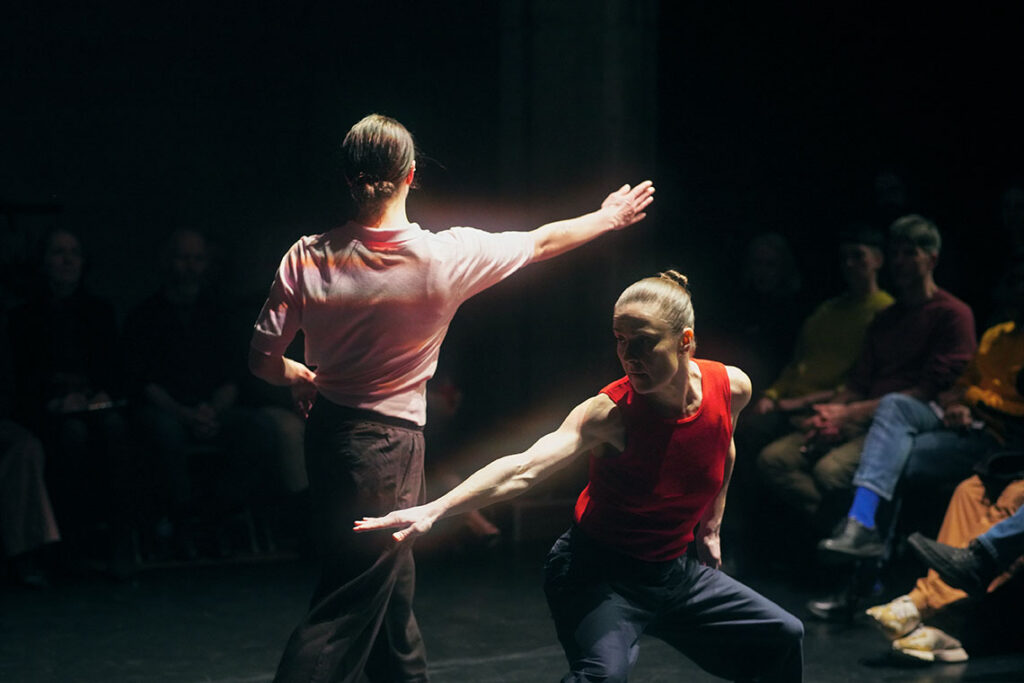
STANDING Magdalena Haylek, Roberta Ceginskaite
One of several festival pieces with a studious feel, in several senses: serious, a study, made in the studio. First Roberta Ceginstkaite, later Magdalena Hayek, torque and pivot, planting and swivelling their feet, gyroscopic arms pushing and pistoning as if to define invisible planes and curves around them. Muffled sounds build into noise, blooms of light flower and fade – and this stark, yet atmospheric compositional study comes to a close, just like that.
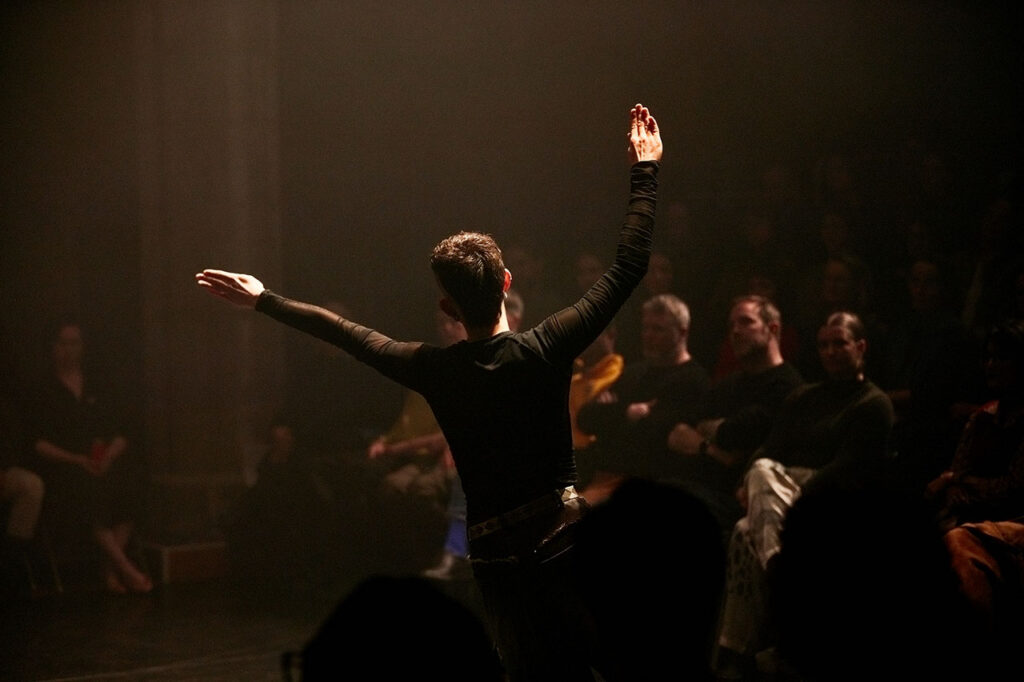
babes gergő d. farkas
Crawling in backwards through a smokescreen is an apt opening for gergő d. farkas’s introverted, unexpository piece: a lot of what happens in this performance is hidden – whether within the body or inside the imagination (farkas’s or ours). Chords mooch and swoon about; so does farkas, corkscrew arms swizzling, bumping their body blindly into the stage edges. Effacing their own already faint presence, farkas finally cedes the space entirely to moody lighting: a cast of absinthe green, a rinse of pink, and finally a warm lamplight glow.
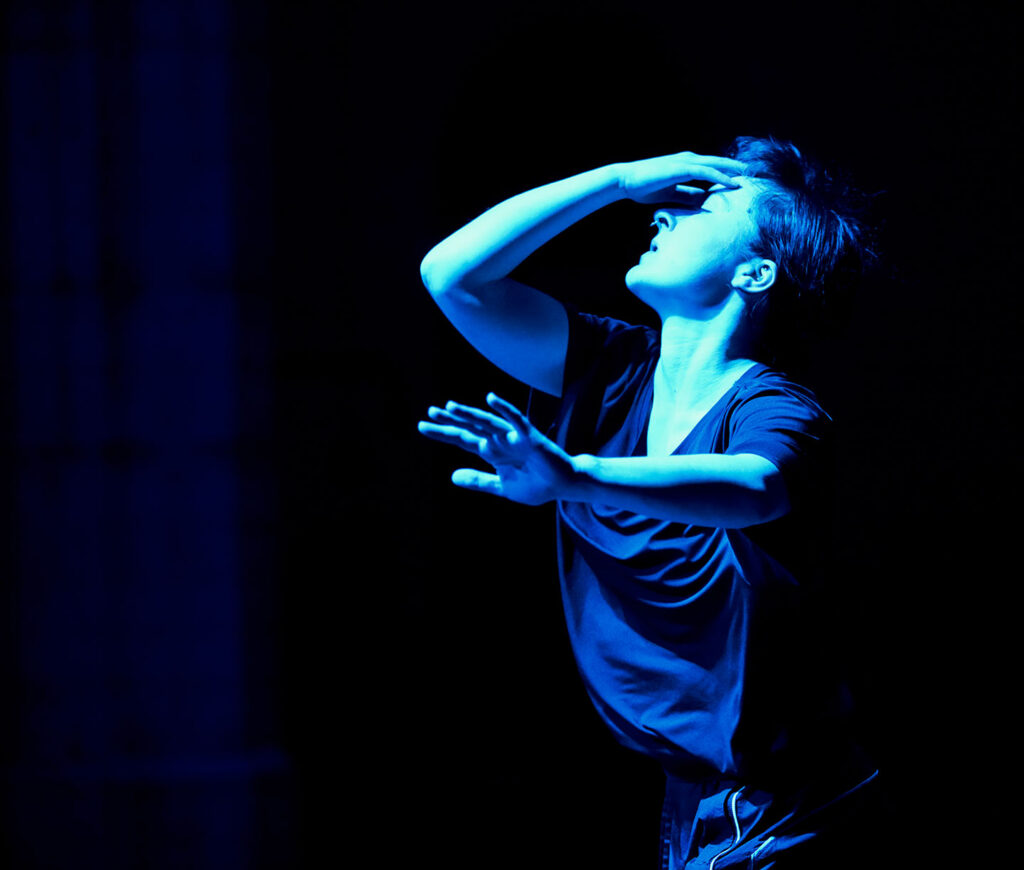
Pit Alex Vostokova
DJ Jack Colley backs dancer Alex Vostokova (evidently gymnastics-trained) as she enters in black ruffled skirt, eyes skyward, and sinks slowly floorwards. Pulling herself out of her skirt, she loops through the audience to pile-drive herself into a vigorous and extreme sequence of forward bends and backwards falls (ouch!), before rolling backwards, galloping around, and finally sinking again floorwards where, joined by her DJ, she listens quietly to the earth. You might not follow the detail, but you’ll certainly be caught by the force and the fierceness.
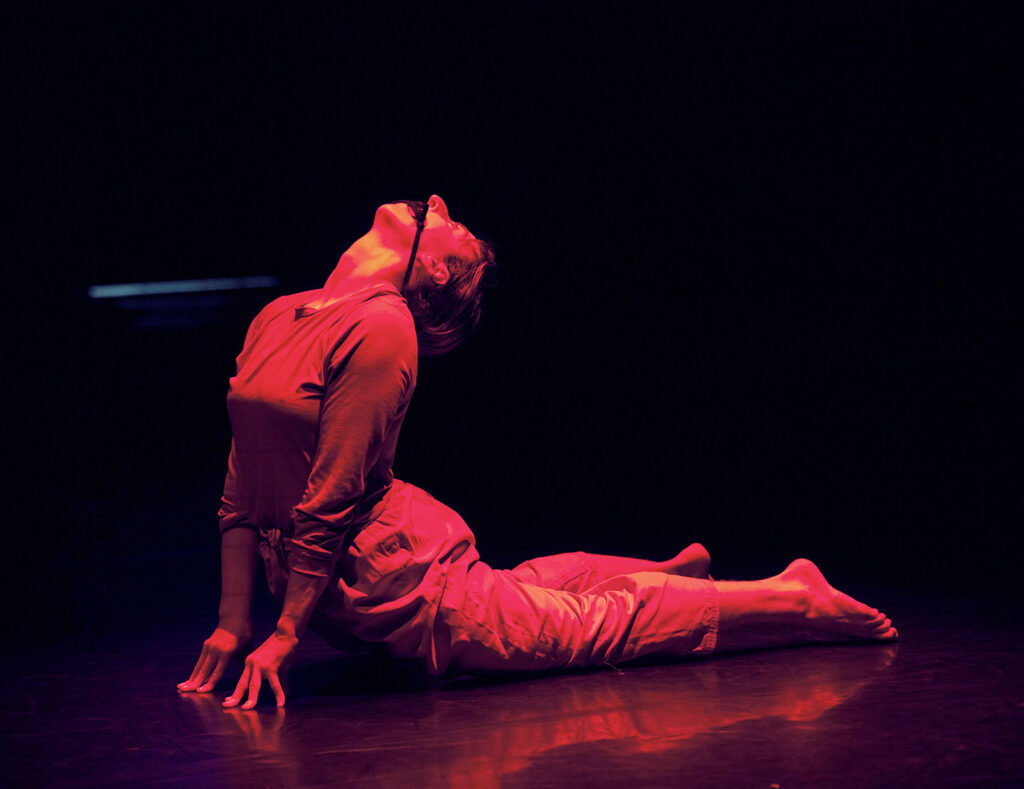
Foot of the Lungs Aoibhinn O’Dea
Short and meditative, this introspective solo sees Aoibhinn O’Dea at first doubled over in a cross between a yogic downward dog and sloth-like ambulations on all-fours. A mouth-organ strapped to her face gives faint voice to her breath, as if echoing her internal state – which becomes more agitated as she stands up, now in more human mode, the harmonica wheezing tunelessly in response to her sideways swings, back towards us as if still guarding her secrets. An atmospheric cameo built around one physical idea, rather than a piece in itself.
Everynothing Salma Ataya
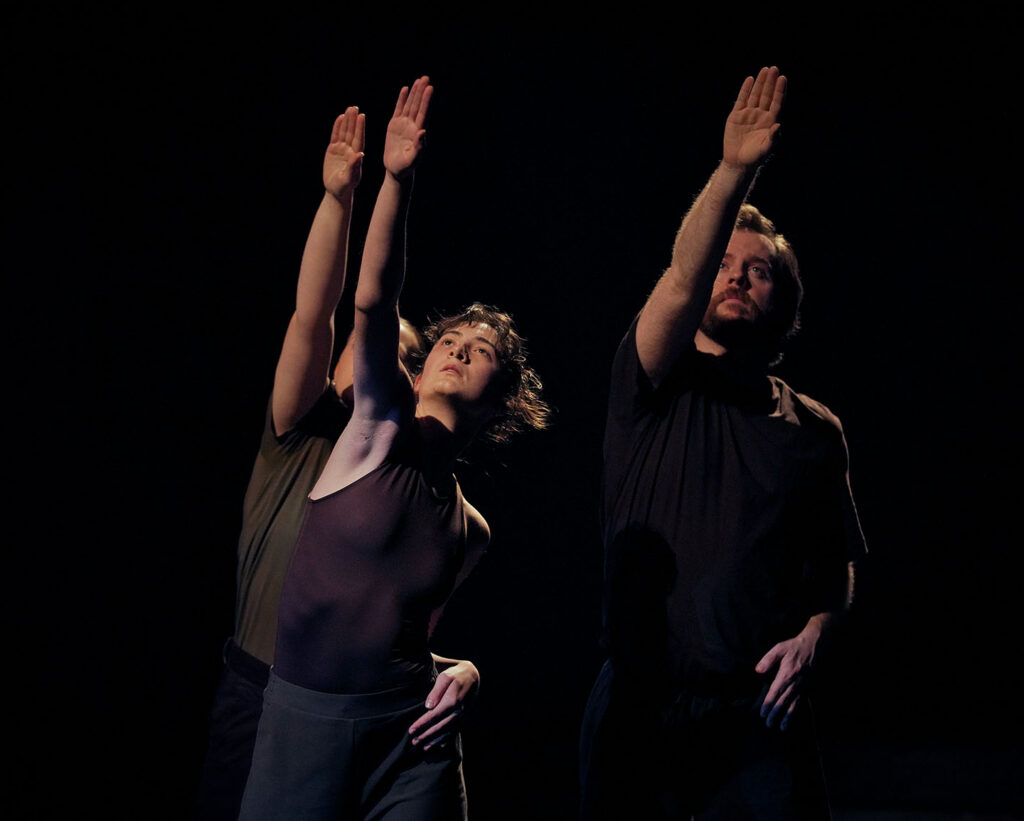
A very tight trio start upstage with small, unison shoulder rolls, torso twists and arm reaches to create a deliberate yet cryptic semaphore that, even as a rhythm settles in, stays tautly restrained. When the dancers separate it feels like a profound, almost shocking break, even though their material is of the same substance, if now more expansive and more loosely distributed. Having spun out, they spin back into a tight cluster and return to their openings – and we, held by their intention, their intensity and the coherence of the composition, return with them, strangely changed
The Shake Laura Murphy in collaboration with Siobhán Ní Dhuinnín
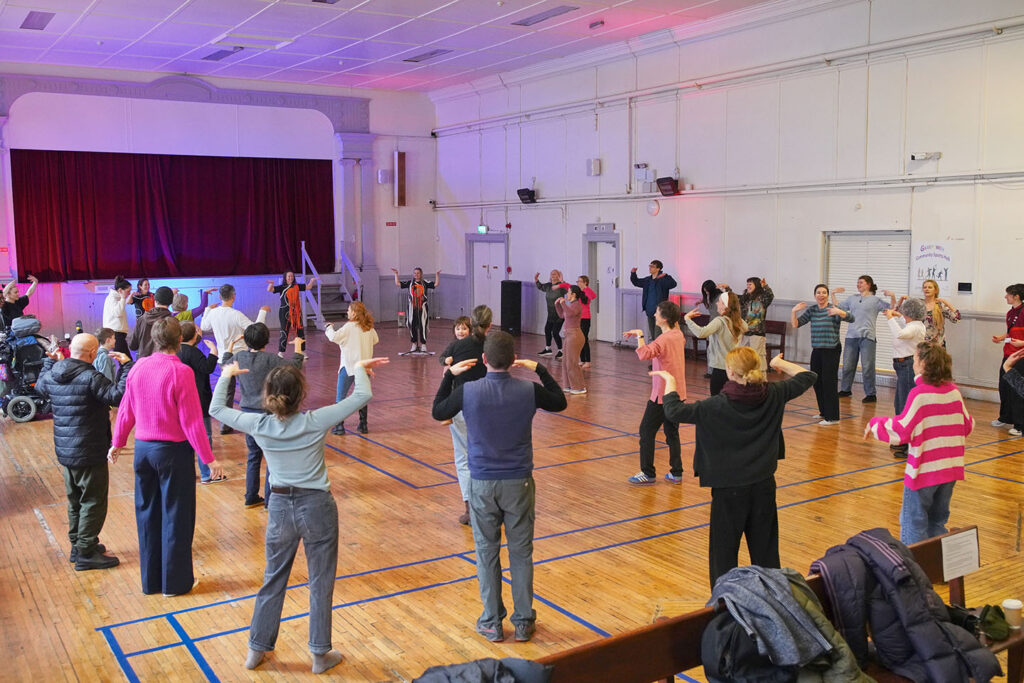
Basically, a bop with three DJs – Laura Murphy and Siobhán Ní Dhuinnín on movement and Jade O’Connor on vocals – while we, the public, are the community of assorted bods who sway, shake, bounce and strut our own stuff. On one level it’s a kind of shamanic rite that wants to shake us out of our everyday alienation from our own bodies; on another, it’s a kind of very wholesome daytime rave, clean, safe and inclusive of those who want to enter. Like a rave, its effects feel quite ephemeral – but certainly fun and freeing while it lasts.
Specific Invisibilities: Dancing The Parsley Collective
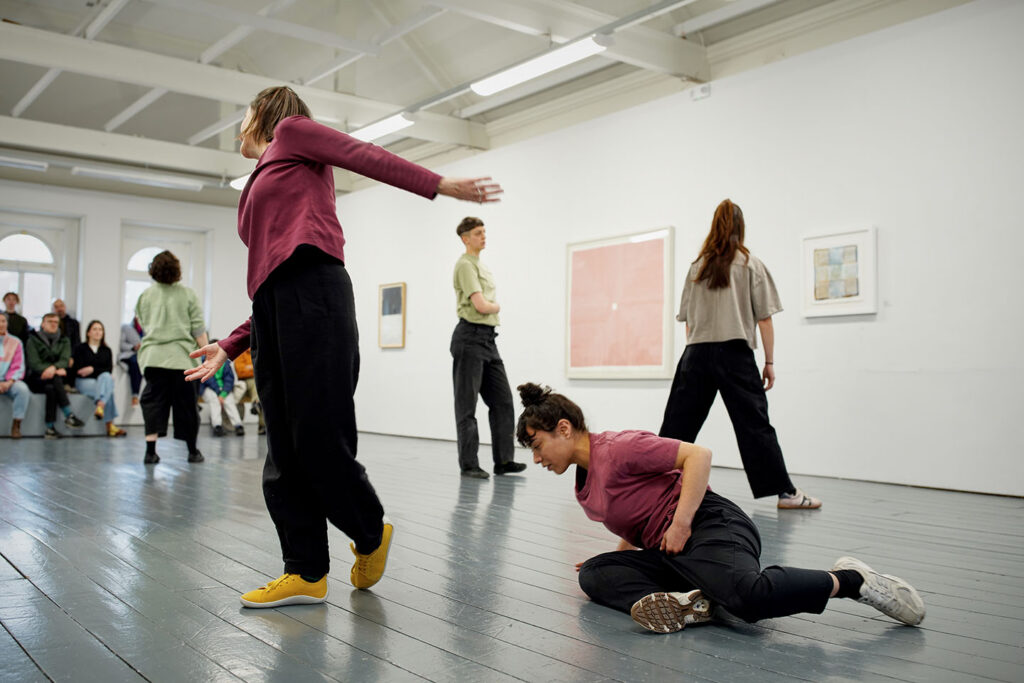
We hear breath, footsteps, a timer, and the ambient sounds of birds and cars from beyond the reverential space of this unassuming art gallery. Five assorted dancers perform six episodes of motion and interaction, each generated from invisible rules and tasks (very Judson Church). Circlings, swivels on the spot, drops and rebounds, pathways that are variously parallel, diagonal, spiral and perimetric which, despite the flurries and quickenings of motion yield less variety of pace and action than you might expect.
Proses on Neither Here nor There Mufutau Yusuf
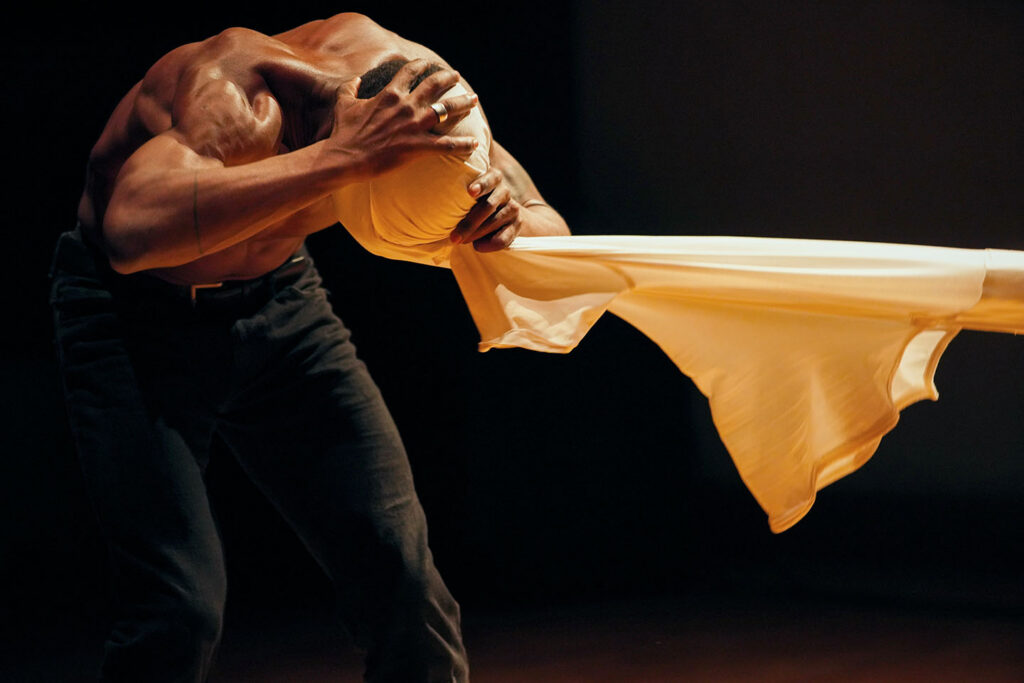
You could take this solo in many ways; me, I couldn’t help but think of Frantz Fanon’s classic text Black Skin, White Masks, on the psychology of colonisation – for here is Mufutau Yusuf, a black man bound by the long, elasticated train of his bright white t-shirt, an almost umbilical rope against which he strains, but cannot escape. Like a creature struggling to be born, Yusuf manages to slip his body from its amniotic white casing, but not yet his face – until finally, to the accompaniment of a chant that soars and struggles, he finds his freedom. The separation is not liberation, though: he carries the marks and memories of his tethering within his faltering steps, his uncertain tumbles, his staggers.
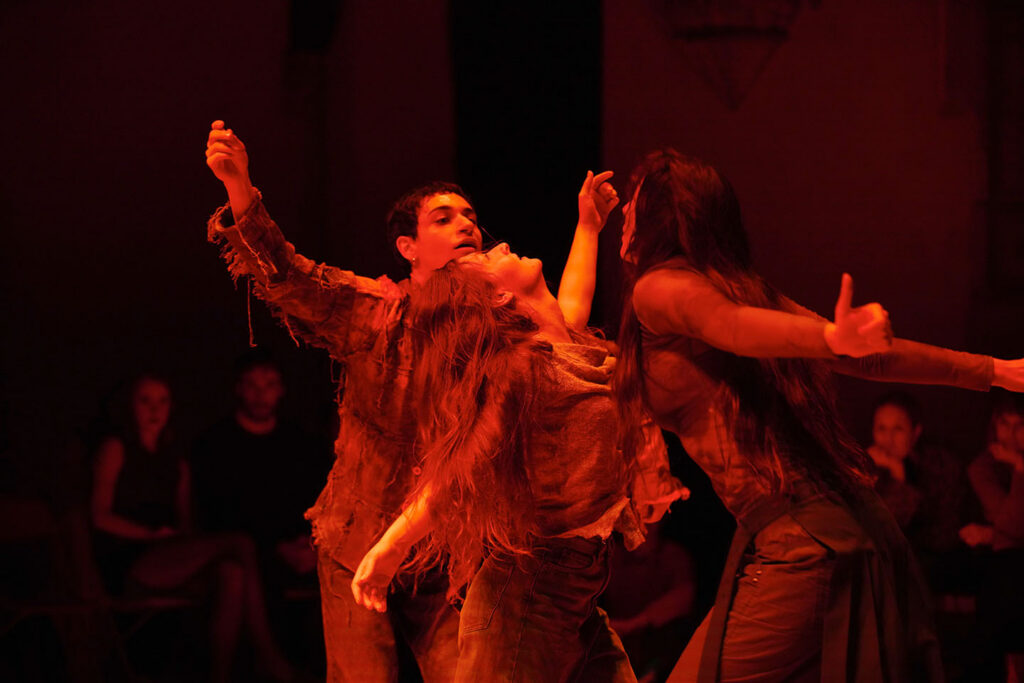
heartquake Ekin Tunçeli
When the ground beneath your feet keeps shaking, how do you feel, how do you cope, what do you do? Those are the questions for a trio of dancers in this earthquake-inspired, drawn-out movement study in which unstable sideways shakes metamorphose into the conscious rhythms of folk dance, into amorphous thrashings, into contemplative sways and unreliable supports. A closing scene of determination and persistence – striding then cantering around the stage perimeter – is inspo, perhaps, to those of us feeling shaky.
What Next Studio: works in progress
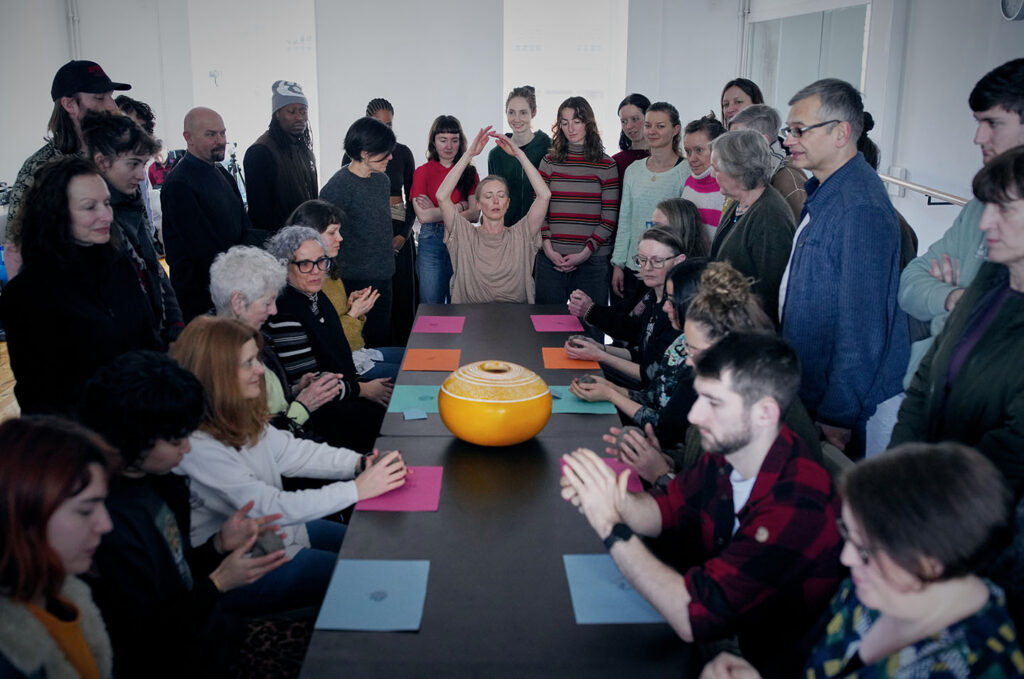
Left-handed Snake Drawing Justine Cooper, Rebecca Reilly
“Is there a part of your body that needs love?” ask Justine Cooper and Rebecca Reilly, each at one end of a long table at which we – celebrants, participant-observers or maybe just guinea pigs in this experiential, experimental rite – mould clay into totemic approximations of our chosen body part (I spotted a foot, a brain, a shoulder, and assorted unidentifiable lumps). Cooper chants like a temple bell, and they both peel off to don shamanic outfits, Cooper masked within tent-like sackcloth, Reilly brandishing a tree branch as she snakes about. The experience lands somewhere in the expanses between wellness, woo, weirdness and wildness.
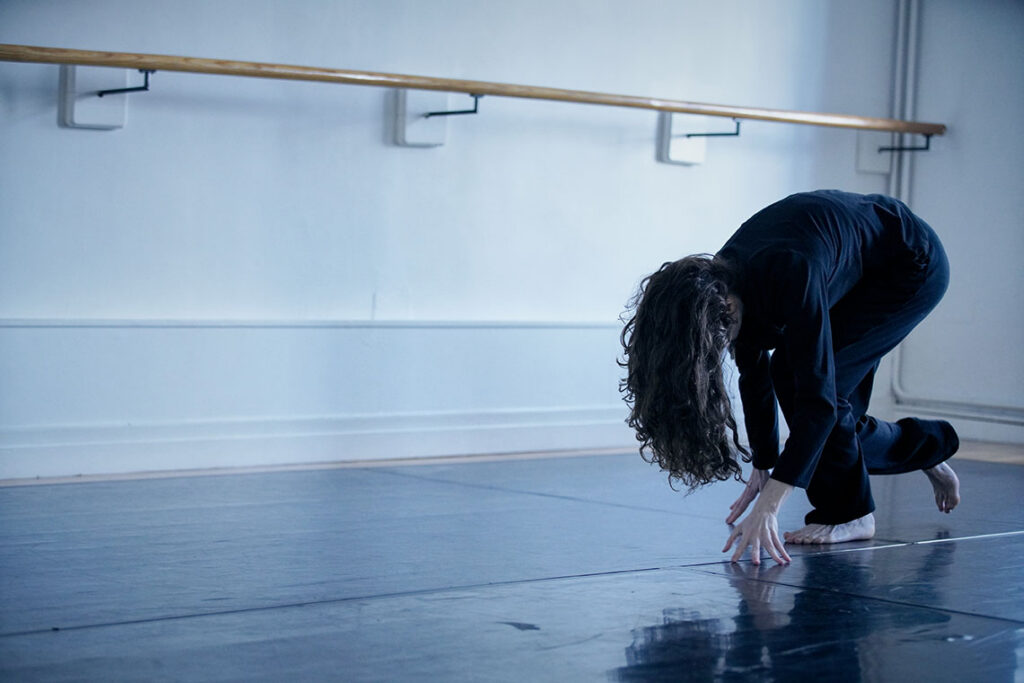
Space Cadet Grace Cuny
Forget three sentences, here’s one word: pow. This section from planned longer piece evolves from slow burner to big hitter, with two forces – sound and voice on one side (music by Jeff Buckley), being and body on the other (dance by Grace Cuny) – meeting in first gently then ramping as guitar breaks detonate thrashes, jogs and sidekicks, repeated like a life force that keeps snagging upon itself. Coherent, all of a piece, tight as a guitar string and loose as a limb – again, pow.
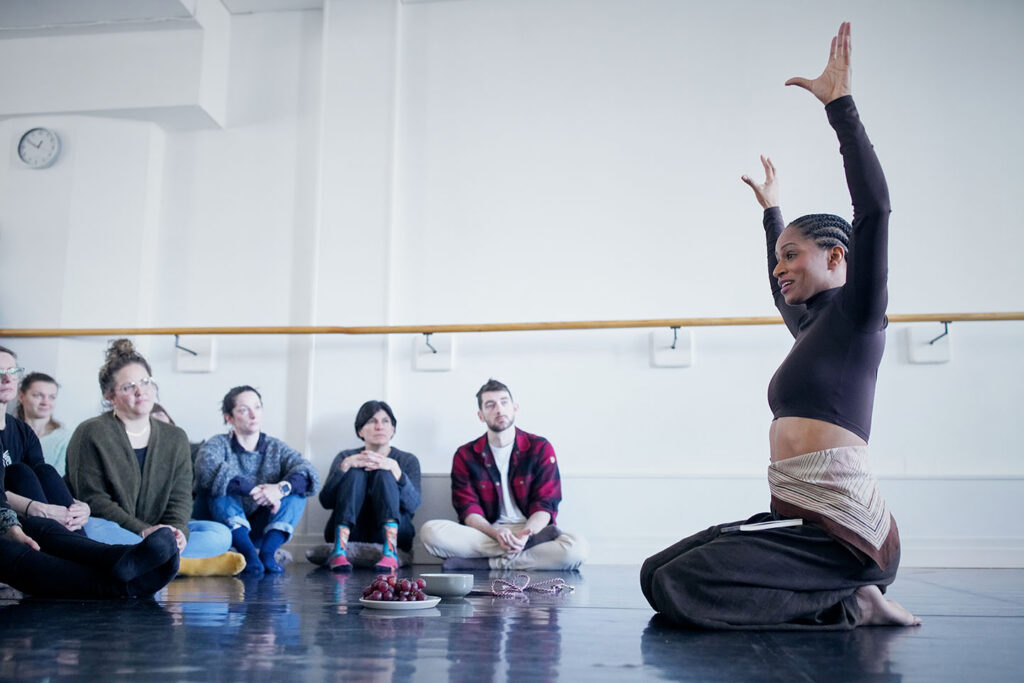
Cosmophobia Alessandra Azeviche
A straightfoward talk about a research project arising from the Brazilian counter-colonial and ecological text A Terra Dá, A Terra Quer (Earth Gives, Earth Claims), as well as Alessandra Azeviche’s own reflections on gardens, land, growth and fruit in her adopted country of Ireland, sneakily segues into a kind of performance, via a sharing of supermarket grapes. A jazzy trumpet coaxes Azeviche into lunges, tumbles and crawls, close to capoeira in style, and focused downwards – earthwards. “If you are going to be soil,” she says, “you must be fertile.”
Memory of the Skin Matt Szczerek
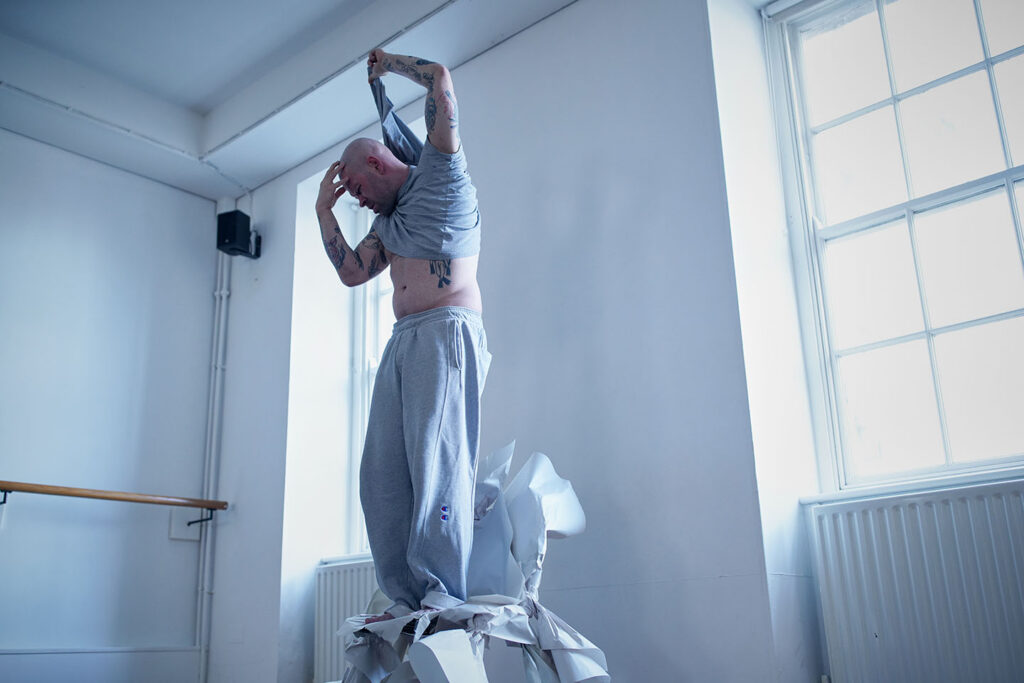
On a throne of sculpted paper, Matt Szczerek looks like an effigy in a t-shirt – but there’s something else inside him that wants to get out: a tickle, an itch, a clawing, a hammering. His fingers spider over the crown of his head, his hands distend his clothing from within, and his arms buzz and flicker with electric, alien energies, independent of his will. The cameo is coherent, focused, sharp and – with a voiceover intoning words about a new age of darkness and confusion – satisfyingly uncanny.