

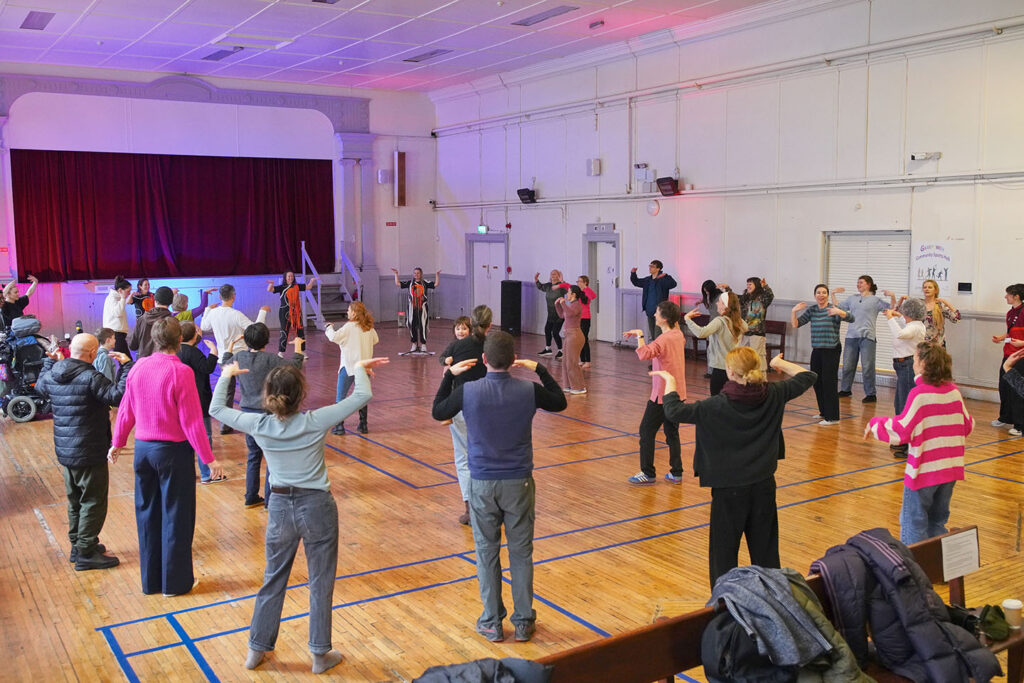
Was it chance or was it choice? (Chance, I reckon.) In any case, What Next Limerick featured two highly contrasting works built on the idea – no, not the idea, the physical fact – of shaking. One was literally called The Shake, a participatory, public event directed by Laura Murphy with Siobhán Ní Dhuinnín that invites us into a kind of loosely curated rave. The other was Ekin Tuçeli’s heartquake, a staged performance which connects its seated audience, via a trio of quaking dancers, to the experience of feeling shaky.
As Tunçeli pointed out to me, the shaking in her piece was essentially lateral, side-to-side, from one foot to the other. On the other hand, Murphy’s The Shake included sidesteps but its aim was towards the higher, upbeat peaks of the vertical: bounces, springs, pogos.
Everything follows from that fundamental difference in physicality. Murphy tells me that The Shake had grown out of regular session she had been practising with other dance artists over several years. “It’s an energetic practice, it’s a physical meditation, it’s a bit of a groove, a bit of a disco,” and has four phases: soft vibrations by way of warm-up; a more pulse-based expansion of that with the feet planted further apart; a further extension so that the feet come off the floor; and finally complete stillness.
That basic practice, opened to and adaptable by members of the public, became The Shake, with Murphy and Dhuinnín as the movement DJs, Jade O’Connor as the vocal DJ, and (depending on circumstances), a further DJ on the sound deck. It’s quite shamanic and ecstatic in nature – like a rave, but open to anyone, drug-free, and with water as its only drink. Its aim or outcome is not performance but experience, individual and collective. We activate our bodies, each according to our circumstances, and we do it as a group.
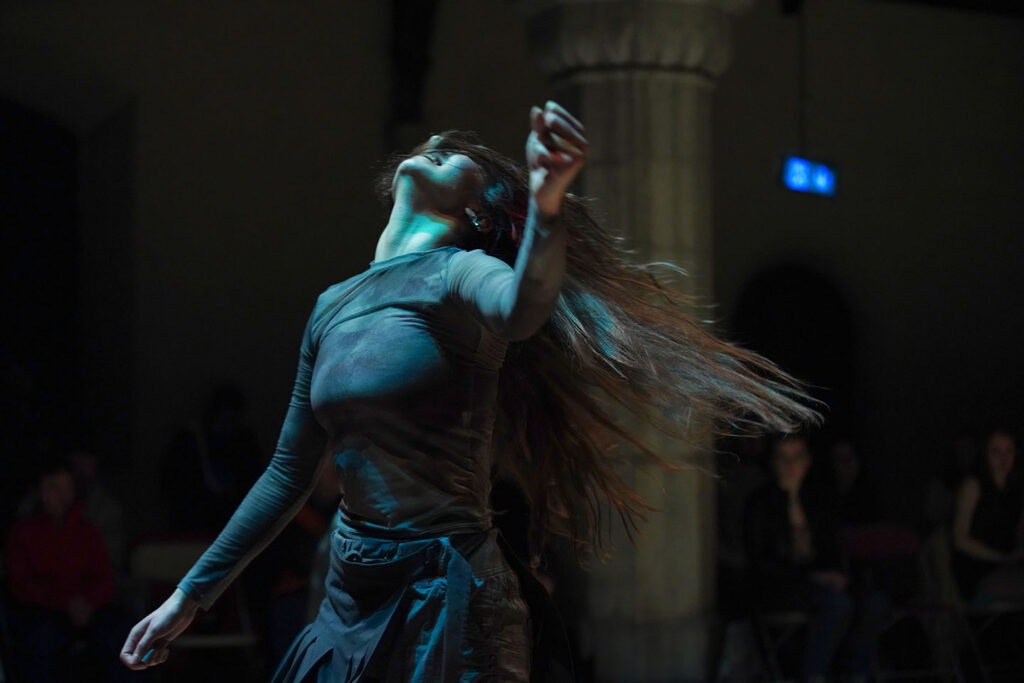
Shaking in heartquake came from quite a different source: not ecstasy and release, but tension and anxiety. At the time of the Tukençeli was living in Sweden at the time of the 2023 earthquakes in her homeland of Turkey. She had grown up with earthquakes, but this one was on a vast and devastating scale. At a distance, in Sweden, she wondered about what the instabilities of shaky ground might mean to people, physically, politically and economically.
From that emerged heartquake, performed by three Turkish dancers, with the audience on all four sides of the stage, so that there is no defined axis or orientation to the work. Its sections are persistent and insistent, each one based on a particular movement idea: a crouched, side-to-side ricochet; back-and-forth scooches on the floor; repeated shoulder shake, like the germs of a folk dance.
It is that germinal folk dance that exposes not just the physical but the dramatic difference between the two pieces, because here, and nowhere else in the piece, the lateral shake becomes intentional, pulsed to a rhythm. Here, the shake has reached beyond movement towards dance, whereas in the The Shake, most of the movement is also dance: we shake voluntarily, and it feels liberating. In heartquake, the performers don’t have that same volition. They appear shaken by their surroundings, and freedom of will – a final determined stride and canter around the stage – is something they must struggle for.