


Alexandra Mihaela Dancs & Vlad Benescu: Somatic Freaks (RO)
Somatic Freaks – The Proprioceptors Revolution stretches the act of balancing into a three-hour performative negotiation, with dancers Alexandra Mihaela Dancs and Vlad Benescu fighting for equilibrium across a long wooden board balanced on top of a truck tire. As they lower onto their knees, tighten through the abdomen, catch, counterweight and rescue each other from collapse, the walk-in format makes the piece feel like a durational state spectators can enter and leave whenever they feel like it. Somatic Freaks relies on imbalance as the catalyst for exploring just how far mutual trust can get you in unstable conditions, not forgetting that falling and then getting back up seems to be a very Balkan survival technique.
Ginevra Panzetti & Enrico Ticconi: ALL’ARME (HR)
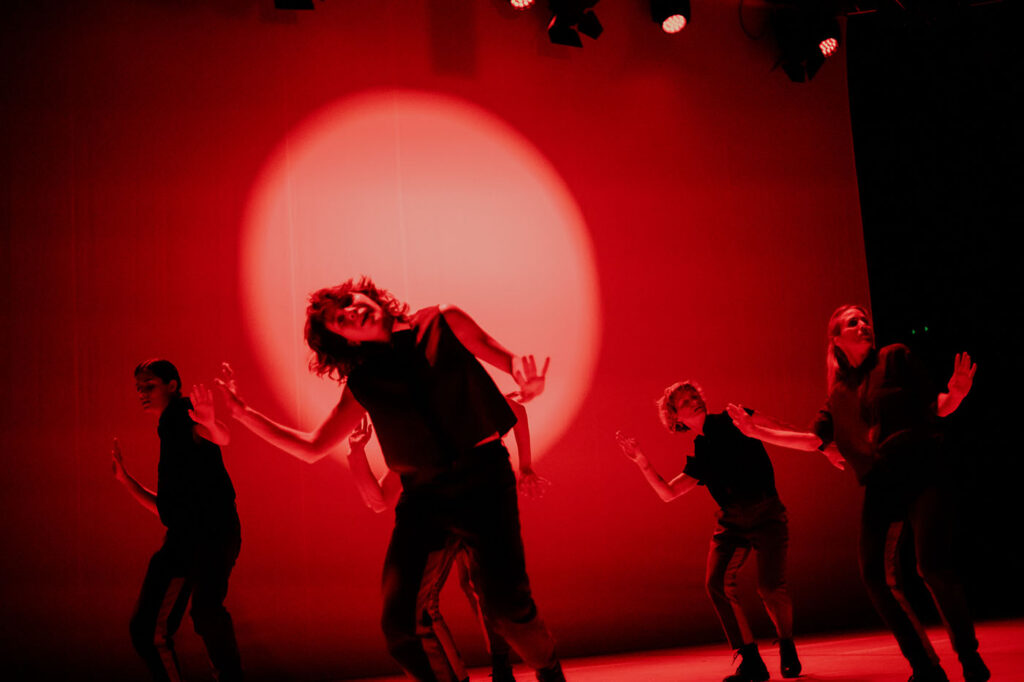
ALL’ARME begins in pitch-black darkness, with six female performers slowly crossing the empty space by lantern-light as if searching for an object, enemy or reason for alarm that never quite arrives, leaving us to imagine what has triggered the emergency. War sounds press against the bodies from every side, from sirens and boots on gravel to shouts and gunfire, while they march, stamp, turn, lock into military synchrony, sometimes slipping into folk and tap-inflected patterns. Borrowing the Italian cry To arms!, the piece keeps safety in a dangerous double exposure, where Panzetti and Ticconi’s military-inspired choreography becomes either the terrifying hint of an approaching war or the soothing impression that someone, somewhere, might still be able to protect us.
Adrijana Danchevska Rovchanin: Mockumentary (MK)
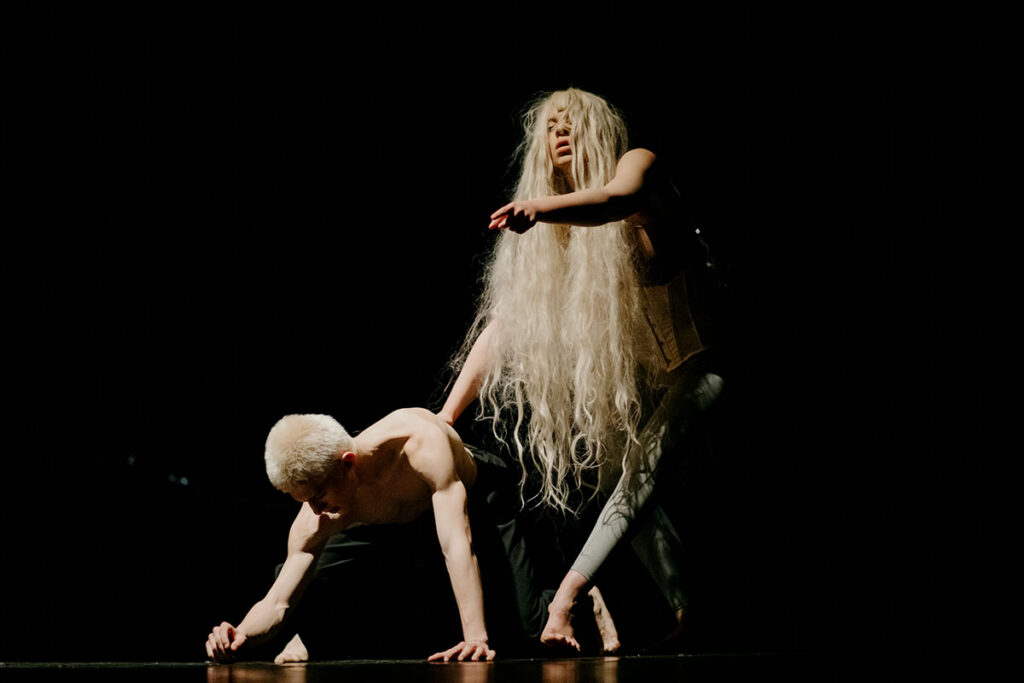
Adrijana Rovchanin’s Mockumentary lets power first appear as hair, in the form of a knee-length blonde wig that Nina Petrushevska untangles, wears and later removes, making authority look disturbingly portable. Across the duet, she contorts her limbs into doll-like angles, walks her ever-adoring blond male counterpart Luka Gjorgjievski on all fours and rides his back, until he takes possession of the wig, fetishises it, and learns to send her down to the floor as well. When the only spoken words arrive, Here we go again, the work’s bleak joke has already landed, because nothing really changes except who gets to hold the leash while oppressor and oppressed keep rehearsing the same choreography from opposite ends.
Enya Belak, Kristýna Peldová: Unfolded Moments (SI)
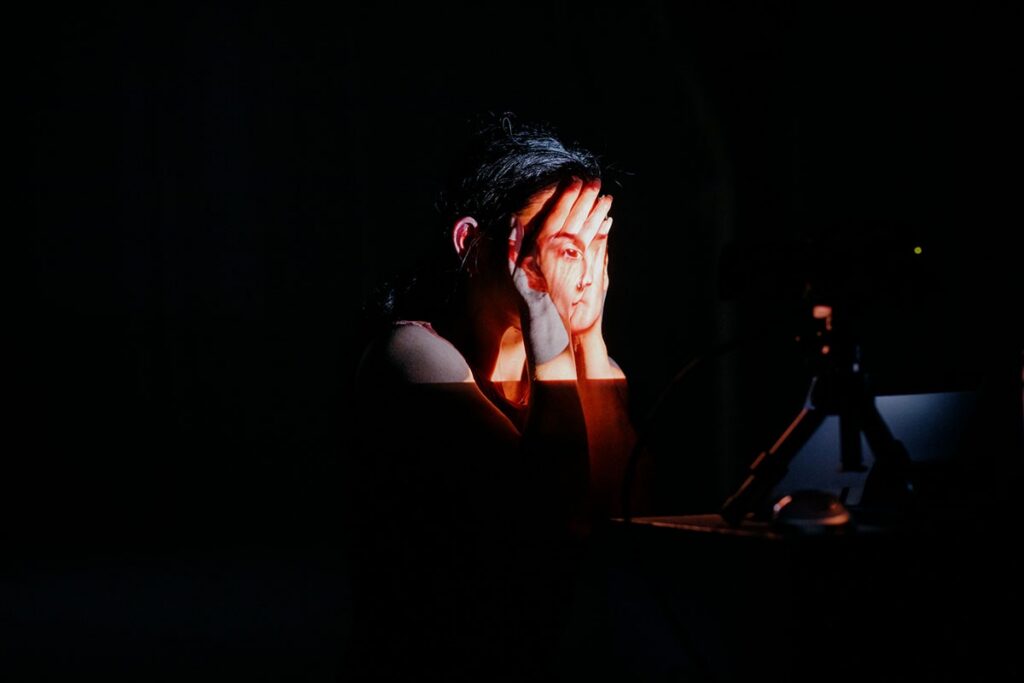
Unfolded Moments places Kristýna Peldová in a white hoodie and trousers inside a dominantly white space, where Enya Belak’s projections make her live body a screen for its own recorded memory, overlapping her present movements with video fragments of a past self rehearsing in a red dress. As light bends through water and glass, perspectives shift, reflections multiply and a huge brown eye hovers across the walls, while Peldová changes into the same red dress, sits before a camera and lets a projected mask settle uncannily over her face, perfect only until fast movement makes the illusion glitch. When the projection of her face moves onto a white veil that she folds again and again until the image becomes a tangled cloth held almost like a baby, this piece’s ending turns memory into something both intimate and unreliable, a self-image you can carry and distort, but never fully unfold.
Kosta Karakashyan: INSERT COIN / PLAYER ONE (BG)
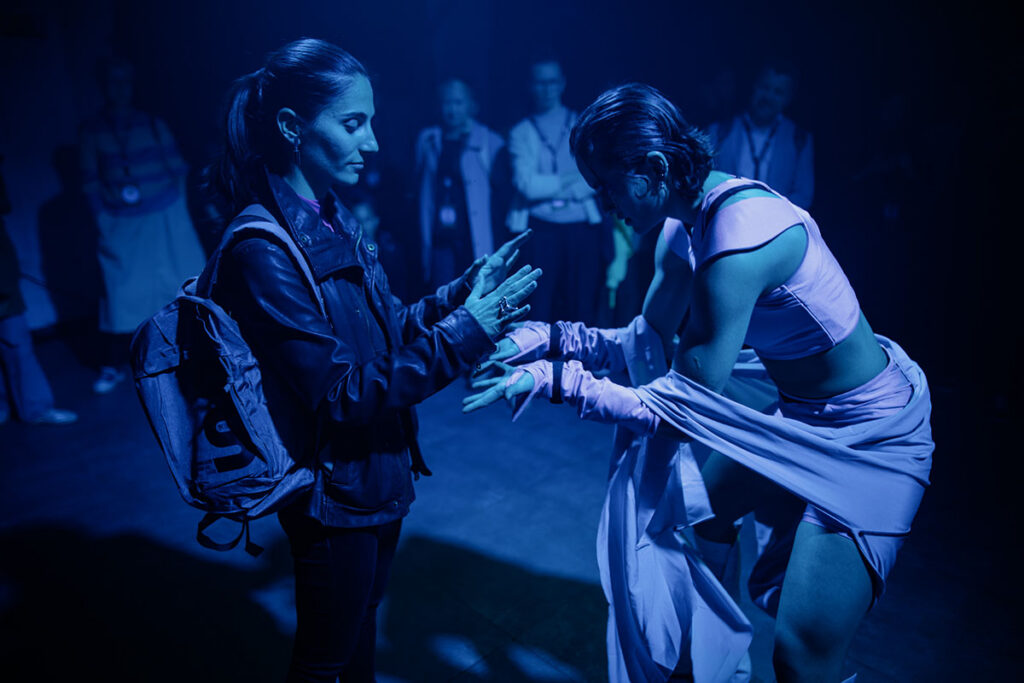
INSERT COIN / PLAYER ONE, directed and choreographed by Kosta Karakashyan with dancers and choreographic collaborators Aleksandar Gochev, Bilyana Tsolova, Emiliya Toncheva and Nelly Georgieva, turned Fabrika into a live-action arcade where each dancer awaited us under a giant colour-coded ring light like an NPC-influencer ready to be activated by the coins we received upon entering. Free to move between the four corners, the audience inserts coins, chats and watches the performers jerk, glitch, seduce and attack with game-character precision, then cheers its favourites through fight sequences that resemble Mortal Kombat (the PlayStation game many of us Gen Z-ers first loved for its shameless mix of gore, violence and button-mashing control.) The dramaturgical structure of the piece may thus become predictable, but the interactivity stays genuinely compelling rather than forced, making INSERT COIN / PLAYER ONE feel like one of those rare dance pieces that could lure Gen Z to dance and trick them into staying.
Ilias Chatzigeorgiou: SCARED (GR)
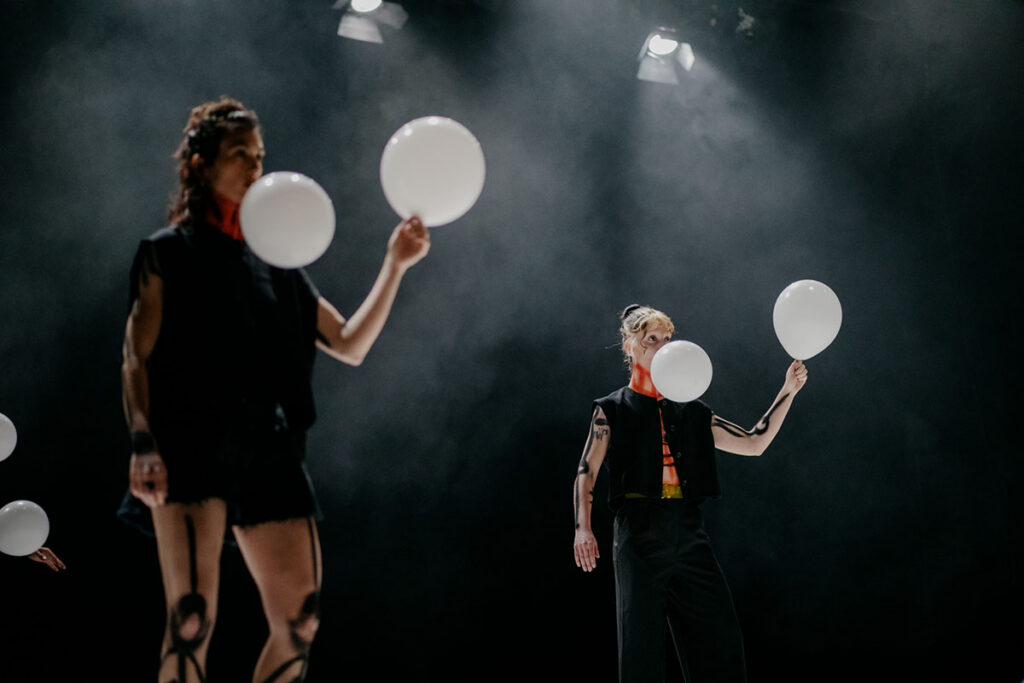
SCARED smells like plastic even before it begins. Ilias Chatzigeorgiou, whose background in hip hop sharpens the work’s pulses, builds a prop-heavy home for a broken family of sad, balloon-popping, cigarette-smoking clowns, who turn domestic crisis into something between a children’s party, a panic room and a bad joke no one can stop performing. After 42 minutes of twisted, uncanny tricks, the smell of plastic still hangs in the air, but so does the sweat, and the bodies that first appeared artificial have made one thing embarrassingly clear: they were human all along.
Deyan Georgiev: Last Orbit (BG)
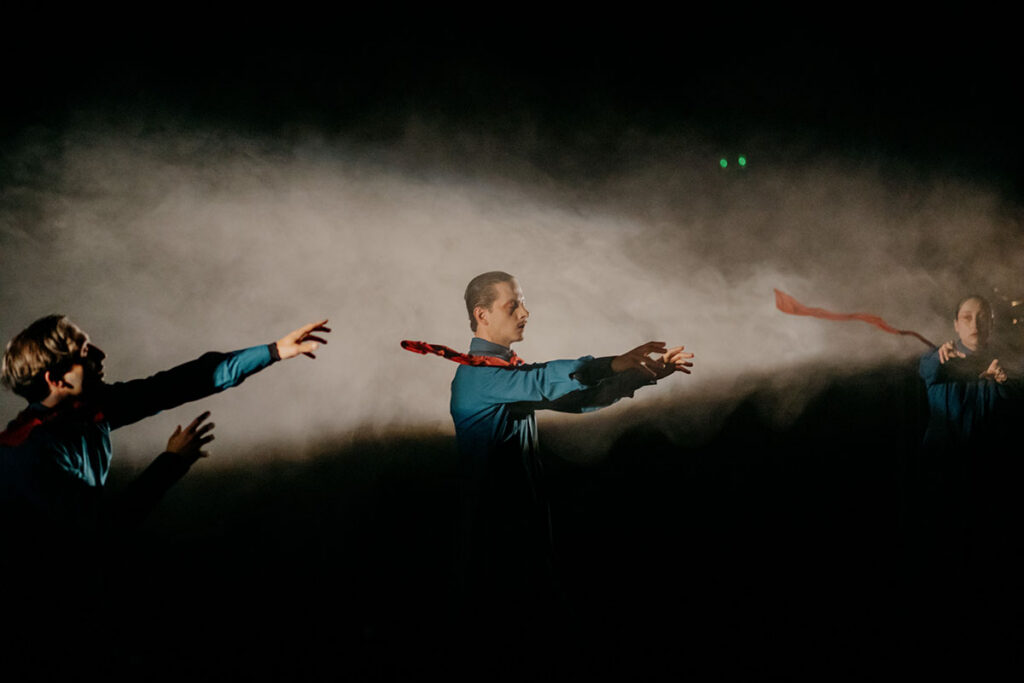
Last Orbit dares to take its time in a world where everything else seems to be on fast-forward. In this visual exercise of imponderability augmented by Viktor Georgiev’s lighting design (for me, one of the strongest of this year’s Moving Balkans selection), performers Bianca Braunesberger, Marina Haralambova, Alexander Gochev and Deyan Georgiev appear almost weightless, while running away from this world into a faraway universe. Minimalist to the point of provocation, with every movement deconstructed, repeated and slowed down, Deyan Georgiev’s piece might be patience-testing for some, deeply hypnotic for others, while giving subtle (possibly unintentional) nods to Antoine de Saint-Exupéry’s Little Prince through its memorable soap-bubble planets and anti-gravity red scarves.
Marta Rak: Appropriations:territory (HR)
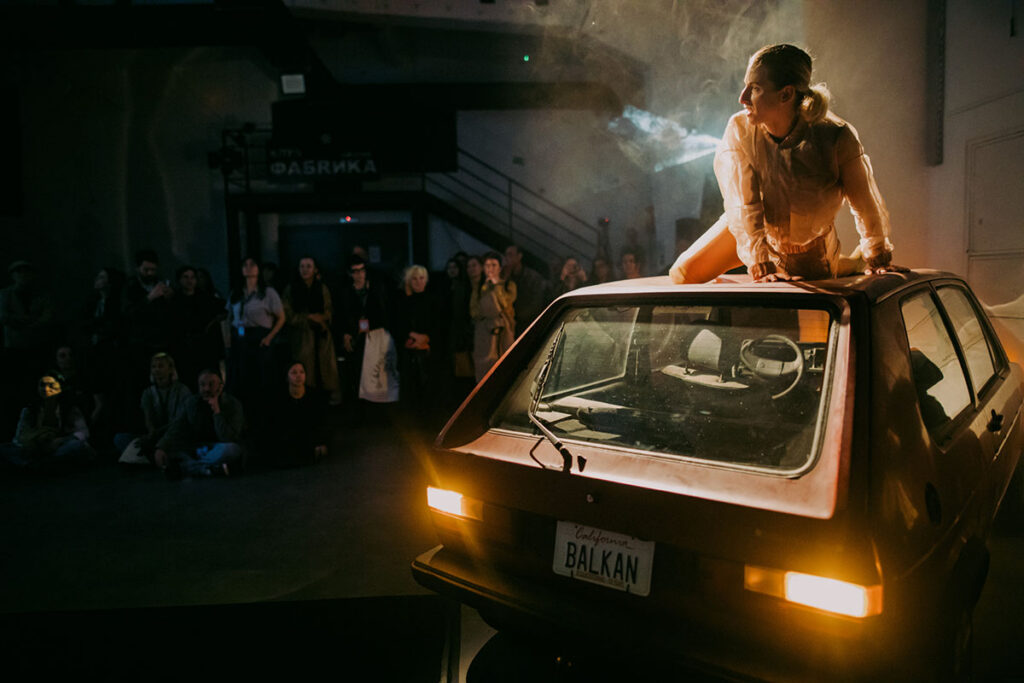
Appropriations:territory (quite literally) squeezes Marta Rak between video, dance and a deliberately eclectic sound collection, moving from folk songs and religious lullabies to football chants and, at one point, Rammstein’s Ausländer. The filmed images, projected onto different surfaces of the all-white set, build her as a mythic figure of territory, hanging naked from a tree branch or standing wind-blown on a cliff, while the live action brings the metaphor down to a red, life-sized Yugo with a licence plate that reads Balkan, which she climbs into, crawls under and then drags across the space, at one point almost through a group of spectators. The piece is strongest when that car takes over and makes people move across the stage; elsewhere Appropriations:territory seems too eager to squeeze too many identities into one vehicle.
Ermira Goro: TELOS (GR)
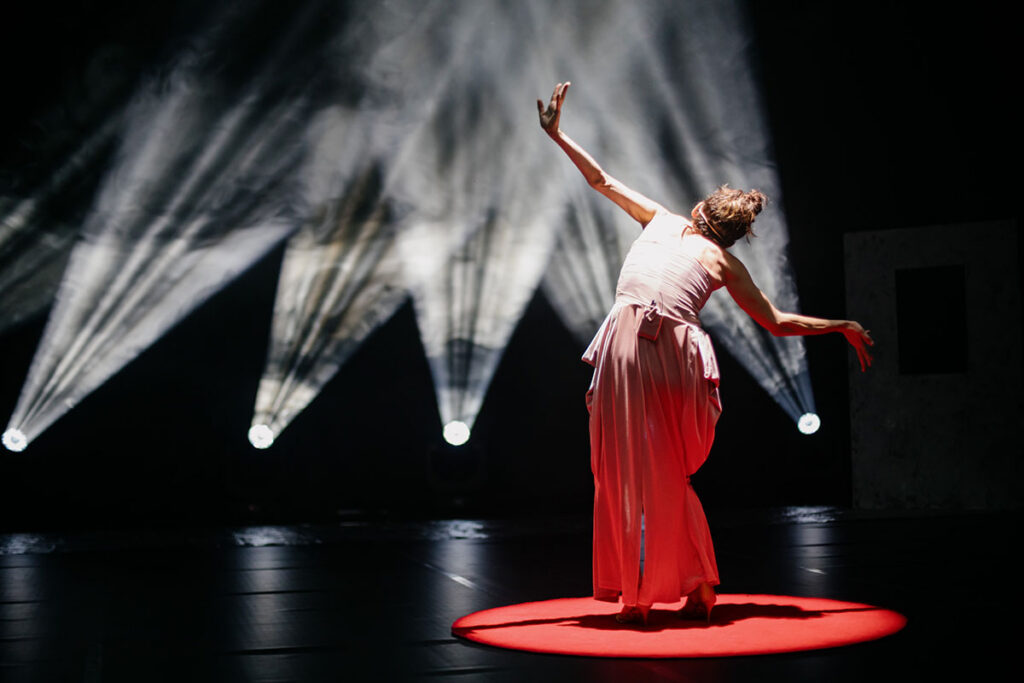
TELOS is a 70-minute modular solo created for Ermira Goro, with choreographies by Maria Hassabi, Hannes Langolf, Ioanna Paraskevopoulou and Goro herself, drawing on the Greek idea of telos as the end. Starting off installation-like, with Goro sitting on a white bench from which she slowly slides for what seems like 20 minutes as the audience stands around her, the piece moves into a more classical black-box setting, where she passes through a sequence of almost separate bodies: producing ASMR sounds, undressing in a miniature bathtub, crawling out, crossing towards a window from which she only half-jumps, then returning in heels and a fancy dress as an actress past her golden years, discussing aging bodies and theatrical vanity. Most of the stuff I do is pretending, she repeats near the end, which may be the sharpest possible summary of a work where telos hints both at the finality of purpose and at the strange professional duty of performing your own disappearance.
Chara Kotsali: IT’S THE END OF THE AMUSEMENT PHASE (GR)
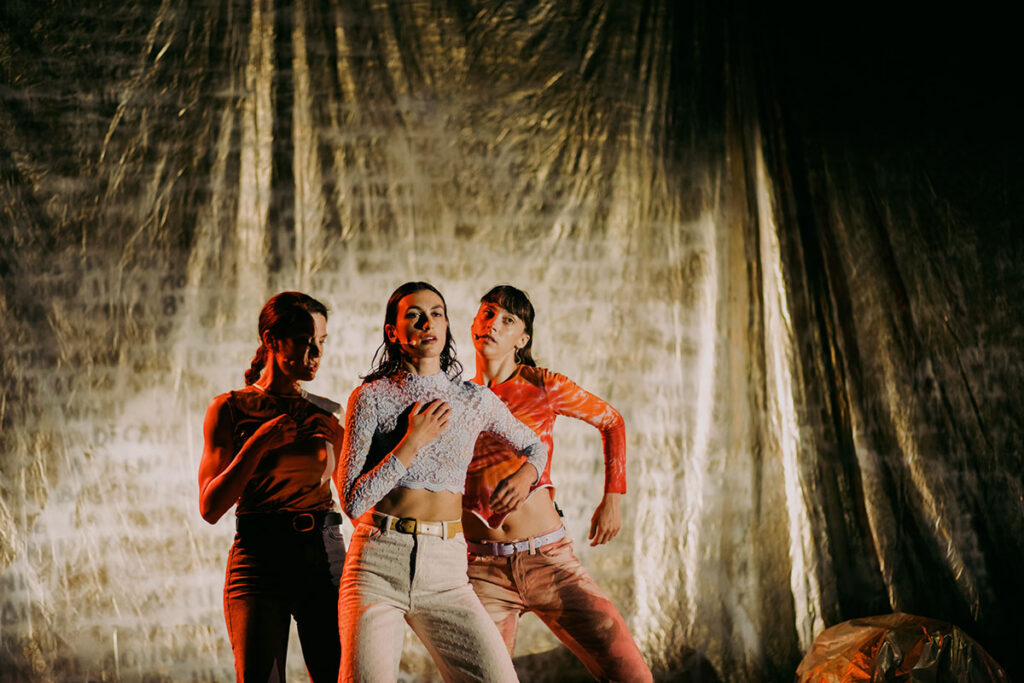
IT’S THE END OF THE AMUSEMENT PHASE has basically made its point by the time dancers Sofia Pouchtou, Christina Skoutela and Chara Kotsali are eating pizza while simultaneously running in circles, because adulthood today does indeed often feel like cardio with toppings. Dressed in Powerpuff Girls-coded colours, they dance, cheerlead, sing, drum, play guitar, smoke, and turn history into a Just dance board as their personal coming-of-age stories as women born and raised in Greece in the last two decades of the 20th century keep colliding with major political, social and cultural events in recent history. Flooded with pop references and a spoken-word manifesto of the millennial generation recited both in Greek and English, Kotsali’s electrifying piece turns micro and macro history into an everything-everywhere-all-at-once dance party, where nobody gets to leave the amusement phase gracefully.