

The first thing Moving Balkans made me do in Novi Sad, Serbia, was walk. This is not a metaphor yet, although of course it will become one later. That is because some of the festival guests, including me, were staying at the historic Hotel Leopold, tucked inside Petrovaradin Fortress, a very Balkan kind of accommodation where breakfast comes with a view (in this case, of the Danube), a functional vintage piano waits on the first floor, chandeliers hang above polished corridors, bits of history surface at every corner, and every attempt to leave the hotel turns into a small lesson in imperial architecture. The fortress sits above the Danube like a large, baroque reminder that Europe has always been very good at defending itself from imagined and real enemies, most of the time with tunnels and bastions, but also with some excellent views.
From the hotel, I could have taken a taxi into the city, but being at a dance festival, it felt only fair that I should move my own body at least once before spending the rest of the day watching other people do it much better. So, from the first day, I chose the one-hour walk. The way into Novi Sad began with steps. Lots of them. Down from the fortress, past the bars thick with lovers’ locks, all those small metal promises rusting away, then past the observation telescope, where Novi Sad appeared across the Danube, then through a tunnel and over the Varadin Bridge. Cars honking, cyclists getting annoyed at pedestrians wandering into their lanes, uneven pavements, graffiti on almost every block wall, fruit and vegetables sold on the side of the road, flowers in buckets, small shops and ten-storey apartment blocks – all these socialist-era residues familiar to anyone who comes from a Balkan country.
Walking past all of these, maybe, is not a bad way to begin a dance showcase. The second edition of Moving Balkans, hosted in Novi Sad from 12 to 17 May 2026, is more geographically settled than its first one, where the showcase moved between Slovenia and Croatia, with Ljubljana, Rijeka and Zagreb turning the regional platform into something closer to a travelling organism. This year, Moving Balkans stops moving, briefly, and gathers itself in one city. Or, more accurately, in several versions of one city.
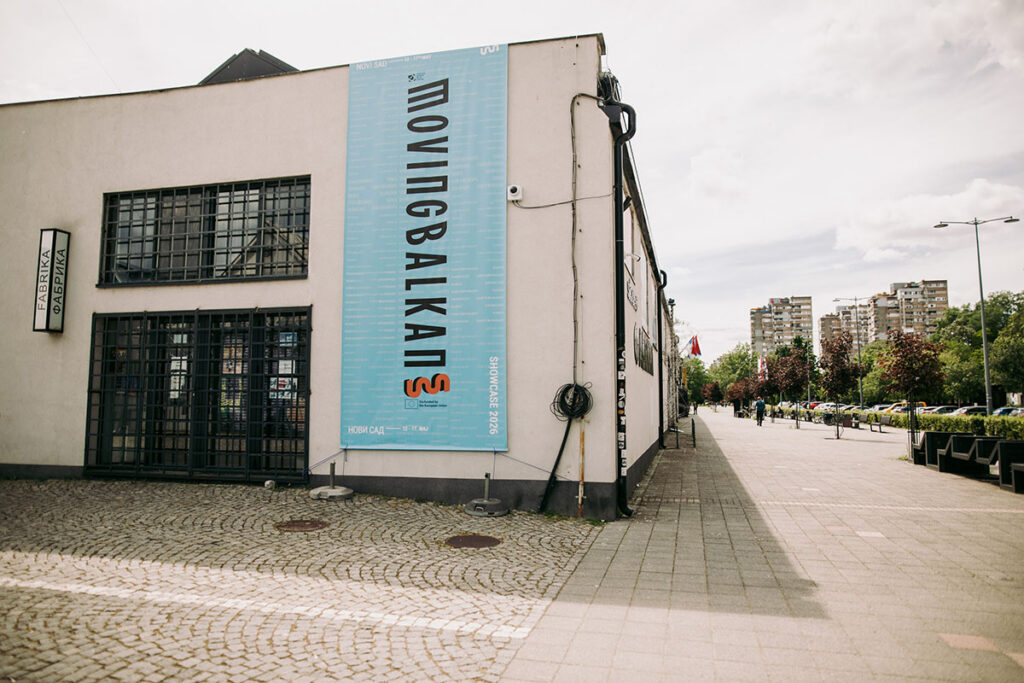
There is SKCNS, the Student Cultural Centre of Novi Sad, where the opening and several performances take place, basically the centre of gravity of the festival. There is Novi Sad Theatre – Újvidéki Színház, carrying in its name the multilingual condition of Vojvodina, the autonomous province in northern Serbia where Serbian, Hungarian and regional histories overlap. There is the Creative District – SKCNS Fabrika, a former industrial zone turned cultural infrastructure, the kind of place that European cultural policy loves. There are also OPENS, Biro and SKUP. And then there is the more informal map of Moving Balkans, with its fair share of coffee, talks, pitches, snacks, QR codes, on-the-move chats between shows, and the terrifyingly delicate art of remembering someone’s name after meeting twenty-seven people before lunch.
The Creative District deserves its own pause. Once known locally as Chinatown, part of the former Petar Drapšin industrial complex in Liman, it was transformed during Novi Sad’s 2022 European Capital of Culture process into a hub for contemporary culture: Fabrika, Liman Cultural Station, art studios, youth spaces, renovated industrial heritage ready to be photographed as a success story. During Moving Balkans, something about the District felt neither abandoned nor fully alive. Several local artists and producers called it a perfect example of gentrification, while adding that it has not yet reached its full potential, because the renovated spaces are still only partially used. The independent dance scene, they said, has repeatedly asked for the right to inhabit some of these new rooms, while meeting institutional resistance. This tension is not new, as even before the title year, local reporting warned that turning Chinatown into a Creative District could marginalise local artistic production, evict existing users and slowly privatise public space.
Bringing together Caroline Sotta from Teatroskop & French Institute in Serbia, Mateusz Czekaj from the Polish Institute of Music and Dance, Anna Arthur from Aerowaves, Iztok Kovač from Pan-Adria Network, and Atanas Maev from Moving Balkans, the “Connecting the Puzzle” panel, held on 14 May at SKCNS Gallery, made this almostness clearer. The main question was how local, regional and European levels can better connect to support the sustainable development of contemporary dance. A sensible question, and therefore a dangerous one. In this region, sustainability is often discussed by people who have survived long enough to be suspicious of the term. What is sustainable when the infrastructure itself is fragile?
During the discussion, Bojan Milosavljević, project manager at the Creative Europe Desk Serbia, offered one of the most useful interventions on the Serbian contemporary dance scene. What stayed with me was not only the list of difficulties – funding, continuity, institutional recognition, production capacity, decentralisation, mobility, the uneven relationship between independent companies and public structures – but the tone in which they had to be named. There is a particular regional exhaustion in having to explain, again and again, that the problem is not talent. The talent, the artists are there, the practices are there. The bodies are very much there, sweating, applying, improvising, partnering, translating, pitching, sending emails at midnight. The puzzle is not missing pieces. The puzzle is missing a table.
This is where I think Moving Balkans matters, but also where it risks becoming too easy to praise. Regional networks are often described in bright, aerobic language, using the usual European project-friendly vocabulary: mobility, exchange, visibility, cooperation, capacity-building. All true and all very necessary. But what Moving Balkans seems to understand, at its best, is that a network is not only a professional tool, it is a survival technology. It creates routes where there are no roads, or where the roads exist but are badly funded, badly marked, and somehow, Balkan-style, always under construction.
For artists from the region, the platform offers more than a showcase slot. It offers context, saying that their work does not have to arrive in Europe as an isolated exotic object – it can arrive alongside other works, other accents, other contradictions, other bodies also negotiating proximity to Europe and distance from its centres. For international programmers and partners, the platform offers something equally important, not a sample of Balkan dance as a ready-made aesthetic, but a regional ecology in motion, with both its asymmetries and ambitions. What Moving Balkans highlights best is that the relationship is not one-directional. Yes, the region needs European networks because visibility, mobility and resources are not abstract luxuries, they decide who gets to continue working, who gets to tour, who gets to be seen. But the European dance scene also needs the Balkans’ stubborn forms of invention, its distrust of clean narratives, its ability to make art from shortage without romanticising shortage, its knowledge that collaboration is vital. It needs a region inventive enough to assemble itself without pretending it was ever a single piece.
This year, Moving Balkans stopped moving and settled for a few days in Novi Sad. Naturally, it still made everyone walk.