

Regional dance festivals such as Moving Balkans are much needed gathering places for choreographers, dancers, producers, programmers, curators and critics alike. For dance professionals who move frequently through these contexts, they might feel like places for meeting old friends and colleagues, exchanging updates, catching up between performances and partaking in casual networking. For newcomers and young professionals in the dance world, such as myself, an emerging dance writer still trying to understand the international dance scene without looking too visibly confused, they can also feel like entering a room where everyone already knows everyone.
Coming into Novi Sad, I thought this would be the case. However, the four days I spent at Moving Balkans proved me wrong – or more precisely, revealed multiple ways in which the Balkans know how to cure social anxiety.
Cure no. 1: Rakija. Take the shot
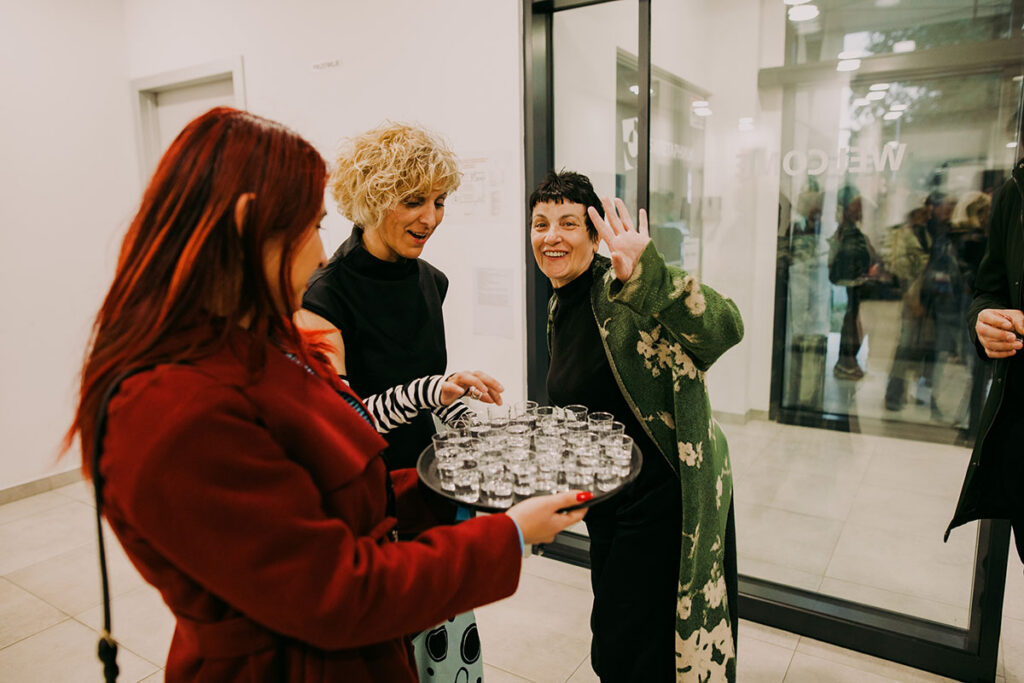
The first cure came in a shot glass, before the opening ceremony had even begun. Rakija simply appeared on a tray before us, courtesy of this year’s Moving Balkans organising team, who knew that no regional gathering should start with dry throats. One sip of this sweet, yet throat-burning drink and our collective nerve-racking choreography of arrival began to loosen. Shoulders dropped, English became more flexible. Someone laughed slightly too loudly, and the room suddenly felt breathable.
Of course, rakija is not just alcohol – it is a way to show hospitality, local pride and family tradition, all compressed into one small, dangerous dose. Before the official speeches, it had already done its job, making the professional gathering less professional, which is sometimes the only way to make it truly useful. And thus, Moving Balkans had begun.
Cure no. 2: No roaming means no Google Maps. Ask the locals for directions
We had no roaming in Serbia, which meant no internet connection outside Wi-Fi zones. And so, walking through Novi Sad became an old-fashioned exercise in vulnerability. No blue dot, no smooth route, no calm soothing voice telling you to turn left in two hundred metres, just the terrifying necessity of asking the locals for directions. First, you have to admit you do not know where you are. Then you have to pronounce the names of places with the full confidence of someone who is almost certainly pronouncing them wrong. After that, you receive instructions that are part English, part gesture, and still have to somehow find your way between multiple performance venues.
Novi Sad, for me, was not only where Moving Balkans happened, it became a city I had to ask my way through. And, annoyingly, this helped.
Cure no. 3: Speed dating, but make it professional. Admit you are overwhelmed
During “Coffee with Top 10 Artists”, we sat over apples and strawberries, and performed the festival version of speed dating. This is a format that should, in theory, terrify me. Once again, I tried to get over this nagging feeling of social awkwardness and just sat down on the first pouf in sight, ignoring the strange pressure of making myself legible in a few minutes. Little did I know this would be the beginning of one of the most insightful conversations I had during the festival. At some point, I confessed that these big international gatherings, where everyone seems to already know everyone, can be overwhelming when you are 23 and just beginning to understand who is who in the dance ecosystem. Greek choreographer and Top 10 artist Chara Kotsali and Czech-based programmer and Bazaar Festival curator Ewan McLaren both reassured me by admitting that they had cried (back in their hotel rooms, of course) after their first experiences with such professional-packed international formats. We had a good laugh together. Everyone has had a first time in the room and everyone has once stood somewhere with a badge around their neck, wondering whether they were doing it wrong. There is something deeply calming about discovering that the people who now seem fluent in the system were also once emotionally defeated by it.
Cure no. 4: Find another writer. Make friends
The social pressure of platforms such as Moving Balkans was something I also discussed, on multiple occasions, with fellow Springback Magazine writer Dmitrijus Andrušanecas. Critics occupy a strange social position at festivals: necessary, peripheral, watched, occasionally avoided, rarely the most popular people in the room. Artists have their teams, programmers have their colleagues, producers have their circuits, while critics drift slightly to the side, with their trusty notebooks on their lap at all times. We are not outside the ecosystem, but we are not fully inside it either.
Once the Springback duo found each other, we gave ourselves a mission. Since we are writers, after all, we decided to engage with at least one choreographer at each evening party and dive deeper into their work in an informal way. This led to lovely conversations with Bulgarian choreographer Deyan Georgiev and Slovenian multidisciplinary artist Enya Belak, some of which also hinted at the social pressures artists themselves feel in these contexts. They run their own emotional obstacle course, trying to be available, articulate, memorable and charming without seeming too desperate in the process. Deyan’s cure was simple – after returning home to Bulgaria, in order to recharge his social battery, he would spend a few days in his favourite forest. We made sure to note that down mentally.
Cure no. 5: Work together as a team. Escape the dungeons
One of the best team-building activities of the festival happened underground, in the Petrovaradin Fortress tunnels. A group of about twenty of us – dancers, choreographers, programmers and writers – entered the underground system and had to work together in order to find our way out. The fortress, already spectacular from above, becomes something else below, with its corridors, damp walls, low ceilings and few, if any, sources of light. A place designed for strategy, defence and confusion – ideal, apparently, for contemporary dance networking.
By the time we came out, we were not necessarily transformed. Don’t get me wrong, I do not believe in over-romanticising group activities. But we had shared a small adventure, and small adventures are among the quickest ways of making people more familiar to one another. Better than a round table, almost as good as the rakija.
Final thoughts for the socially anxious
Moving Balkans, like many regional platforms, exists because dance scenes need more than stages. They need the informal infrastructure through which work starts to circulate before it becomes part of someone’s programme, review or funding report. What I usually think of as networking, with all its professional awkwardness, began in Novi Sad to look less like a social test. This, perhaps, is the Balkan cure for social anxiety. Not confidence or ease, and definitely not the sudden ability to become fluent in every room, but the understanding that awkwardness is not something you have to solve before taking part. Simply being in that room might turn out to be all that matters.