
Is E’BAL anything like Kate Bush? What a question! One is a regional Italian network for the promotion and distribution of contemporary dance, and the other is – well, the other is Kate Bush.
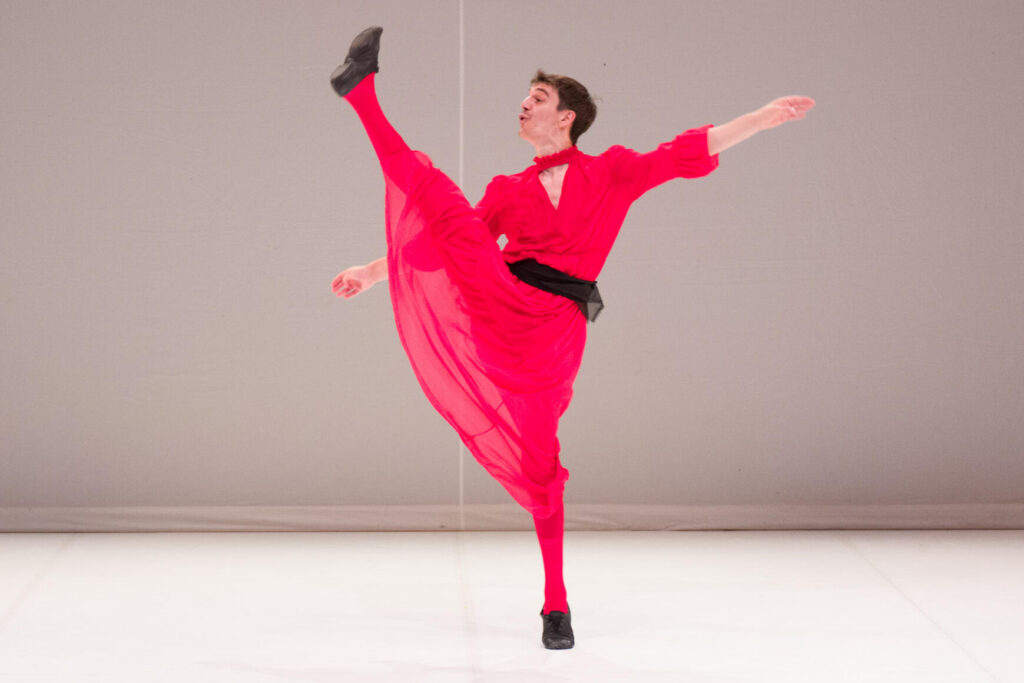
And yet, while talking with dancer Davide Tagliavini of Gruppo Ibrido, whose show AiAiAi Pinocchio! was presented by E’BAL in Ravenna in May 2026, I began to see a connection.
On one level, it’s more coincidence than connection: Tagliavini is a diehard Kate Bush fan – so much so, he told me, that he was going to the UK later in the year to work on a show partly inspired by her (entitled Special K, it was later presented at NID New Italian Dance). “She is my hero!” he says simply, smiling broadly and very happily.
But ask a little more about why he is such a fan, and some more interesting connections emerge. First, there is Bush’s own interdisciplinarity, which sits well with his own company, Gruppo Ibrido. “Our core,” says co-founder Cinzia Pietribiasi, a digital artist and researcher as well as a performer, “is to hybridise our own backgrounds and skills.” Tagliavini, a dancer, choreographer and performer, elaborates: “Kate Bush is a hybrid artist. She’s a singer, of course, but she’s also a dancer, an actress, a performer, a writer, a videomaker. She didn’t train in all these things, but she became all these things, by embodying what she felt inside.”
In short: for Kate Bush, the kick inside gave rise to amazing and many-faced creations.
Another aspect of Bush’s work that Tagliavini admires: her imaginative freedom. “Ever since I was young, that has been an inspiration. To feel liberated, to have fun, to take pleasure in movement, in performance, in connecting with the audience.” Such freedom is both part of Bush’s “craziness” – to be unfettered by convention – and intrinsic to her appeal. “I want that kind of craziness,” says Tagliavini, “to have fun with the power that we have in our bodies, and to transmit this power to the audience. I think contemporary dance can do that.”
It’s true, I say, that contemporary dance embraces interdisciplinarity, and seeks freedoms – desiring to break out, to forge forms and to give vent to feelings that are not contained by genre or convention. I can see the parallels, especially as Bush, particularly in the early days when her sheer novelty accounted for some of her popularity, was also an easy target for caricature because of her affinity with contemporary dance, mime and performance art.
Yet Bush followed her own path regardless, and the world came not only to expect but to respect her idiosyncratic, offbeat achievements – and to love them too. She has been both singularly artistic and multiply popular.
Has contemporary dance? In some ways, yes. It is far more widespread now than it was in the twentieth century, with countless courses, choreographers, performers and venues. The fact that E’BAL exists at all is a testament to the growth of the field, one that E’BAL cultivates by connecting programmers, venues, dance artists and audiences, not just in the cities but across the region.
In other ways, no. It still has the reputation (discussion point: deserved?) of being obscure and insiderish. Tagliavini gives an example of someone he knows well, who can love the films of Almodóvar and Truffaut – and the music of Kate Bush – but still be baffled by contemporary dance. What can be done?
E’BAL aims to remove barriers, with talks, education and engagement projects around the dance works they programme. But perhaps the key is not knowledge, respect or understanding, but love. We can matchmake art and audiences all we like, but genuine feelings of attachment, adoration and care cannot be prescribed, only appreciated and supported when they do arise.
So, is E’BAL like Kate Bush, then? In reality, maybe not. In dreams? Maybe yes! The Kate Bush sweet spot is plural in style, artistically authentic, popular in practice, inspiring for many – and what’s not to love about that? Maybe we can all dream a little more, however crazy that might seem.